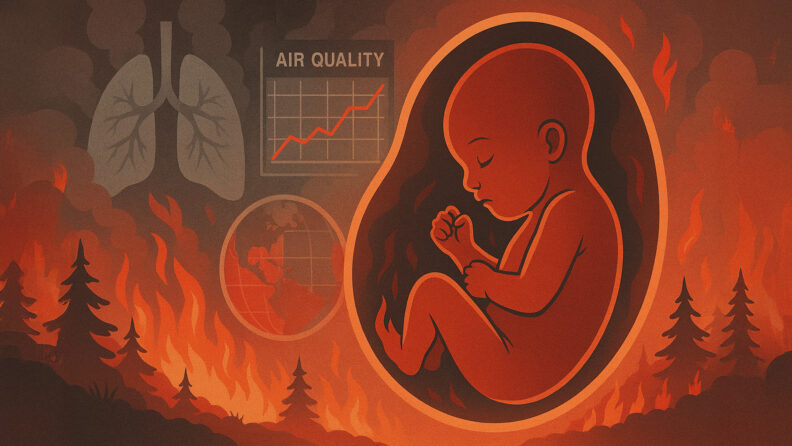
Nursing and climate health researchers Dr. Tara Marko California State University San Marcos, Dr. Lois James, and Dr. Julie Postma, WSU College of Nursing, are among a multidisciplinary team that analyzed over 500,000 births in Washington State to investigate whether exposure to wildfire smoke during pregnancy impacts neonatal outcomes.
Their study, published in the Journal of Obstetric, Gynecologic & Neonatal Nursing, examined 526,649 singleton births in Washington from 2010 to 2018. Using advanced geospatial analysis, the research team linked maternal addresses with daily air quality data to determine in utero exposure to wildfire smoke, specifically PM2.5 particles.
Key Findings
- Gestational Age: Smoke exposure in the second trimester was associated with a small decrease in gestational age. The first and third trimesters showed small increases, though none of these changes were clinically significant.
- Birth Weight: A minor increase in birth weight was observed with exposure in the second trimester and overall pregnancy, again without clinical impact.
- NICU Admissions: Exposure during trimesters 1 and 2, as well as any time during pregnancy, was linked to a statistically significant but clinically negligible increase in NICU admissions (0.002% to 0.003%).
- Apgar Scores: No meaningful changes were observed in Apgar scores at 5 or 10 minutes after birth.
Why This Matters
As climate change intensifies wildfire seasons, understanding how smoke exposure affects maternal, and child health becomes increasingly urgent. While this study found limited short-term clinical effects, it raises concerns about long-term implications and underscores the need for better public health preparedness, especially for vulnerable populations like pregnant people and newborns.
“Our findings add to a growing body of evidence on environmental exposures during pregnancy,” said Tara Marko, lead author. “Although the statistical significance was clear, the clinical significance remains limited. That doesn’t mean we shouldn’t pay attention — it means we need more targeted, precise studies.”
Dr. Tara Marko, California State University San Marcos
A Nursing-Led, Multidisciplinary Approach
This study reflects the leadership of WSU’s nursing faculty in addressing environmental health challenges. Dr. Lois James contributed her expertise in study design and statistical analysis, while Dr. Julie Postma, known for her work on air quality and public health, co-mentored the student with Dr. Von Walden, Professor in the Department of Civil and Environmental Engineering, on a prestigious NIH-funded fellowship.
Next Steps and Public Health Implications
The researchers call for:
- Improved personal exposure monitoring during pregnancy
- Tailored public health guidance for expectant parents during wildfire season
- Policy support for cleaner indoor air environments and emergency planning
- They also recommend risk communication strategies for clinicians and communities, especially as wildfire-related hospital visits are on the rise.
“Pregnancy is a window of vulnerability, and the health of the next generation starts in utero,” said Postma. “We must continue advancing research, advocacy, and education in this area.”
Dr. Julie Postma, WSU College of Nursing
Read the full study
“Associations Among Exposure to Wildfire Smoke In Utero and Neonatal Outcomes” is available open access here: JOGNN Publication.
Share this article to help raise awareness about climate-related health impacts.
Stay Connected
Follow WSU College of Nursing on social media for college updates and alumni news: Facebook, Instagram, LinkedIn, Threads, BlueSky.
