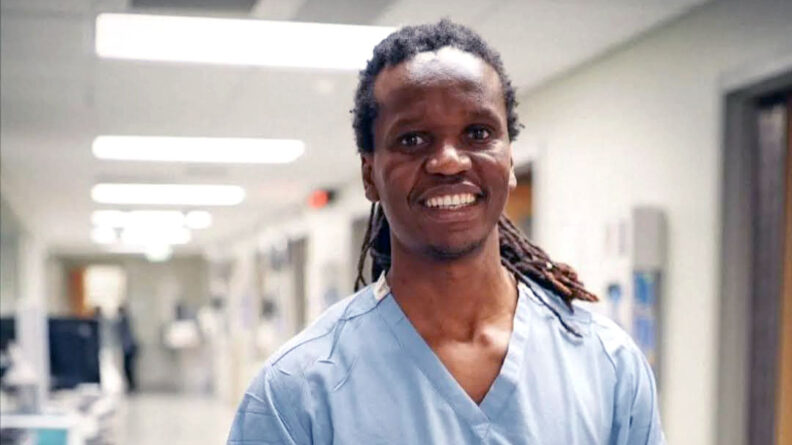
Cosmos Buendasi, BSN ’21, MN ‘24 , RN, did not slow down after earning his associate degree in nursing. He had just finished his program at Seattle Central, started a new job, and welcomed a new baby into his family. For many people, that would have been the moment to pause. For Buendasi, it was the moment to keep moving.
He knew that stepping away from school could easily turn into putting it off indefinitely. If he was going to complete his bachelor’s degree, it needed to happen while the momentum was still there. What he needed was a program that fit real life — one that could work around shift schedules, a growing family, and the demands of a new nursing role. WSU’s hybrid RN-BSN program offered that flexibility.
Before enrolling, Buendasi compared several options, including other online and regional programs. A colleague who had attended WSU spoke highly of the experience, which prompted him to reach out. The quick, personal response he received from RN-BSN advisor, Jenny Schrock, made the decision easier. After sending in his transcripts, he received a reply that set the tone for the entire journey: “Do you want to start next week? School starts next week.” Within days, he was enrolled. The process felt accessible, direct, and supportive from the beginning.
Once classes began, Buendasi was struck by the level of engagement from faculty and staff. Much of the program operated virtually, yet he never felt disconnected. Emails were answered quickly. Questions were welcomed. Advisors were proactive. Even without meeting some of them in person, he experienced a strong sense of belonging. The environment felt less transactional and more relational — something he describes as feeling like family.
Balancing school with night shifts and parenthood required discipline. Buendasi built a structured routine, blocking time for readings, assignments, and discussion posts. He worked ahead whenever possible, especially before stretches of overnight shifts, so he could focus fully on patient care while on the job. The transition between night and day schedules was often the most difficult part, but careful planning kept him on track. While there were moments of overwhelm, quitting was never on the table.
A pivotal source of support came from faculty, including Dr. Catherine Van Son, who helped him secure clinical hours when placements proved challenging. That guidance reinforced that he was not navigating the process alone.
Academically, the RN-BSN experience shifted Buendasi’s perspective on nursing practice. The coursework deepened his understanding of research, evidence-based practice, and the broader healthcare system. Instead of focusing solely on treating illness in the moment, he began thinking more about prevention, population health, and long-term community outcomes. The degree strengthened his analytical approach and expanded how he viewed his role as a nurse.
Professionally, the BSN brought tangible benefits. It increased his earning potential at the University of Washington (UW) Medical Center, where he has continued working in the emergency department since graduating in 2021 from the WSU Vancouver location. It also positioned him for future growth in a system that increasingly expects bachelor’s preparation.
But for Buendasi, the RN-BSN was not the destination. The positive experience with WSU encouraged him to continue. In 2024 he went on to earn his Master of Nursing in Population Health and is now completing his Doctor of Nursing Practice (DNP) in the Family Nurse Practitioner track. His DNP project focuses on diabetic retinopathy screening, a program evaluation in a community healthcare setting, and work that reflects his growing interest in chronic disease management and prevention. His project has been accepted for presentation at the 2026 Western Institute of Nursing conference, marking another milestone in his academic progression.
Alongside his clinical work, Buendasi has mentored nurse residents through UW’s mentorship program, helping new graduates transition into practice and elevating their concerns to leadership. Looking ahead, he plans to move into community-based care and eventually teach future nurses, extending the same support he once received.
When asked what he would tell nurses who feel too busy to return to school, Buendasi points to his own experience: a new baby, a new job, and night shifts did not prevent him from finishing within a year. He emphasizes that flexibility exists within the program and that consistent support makes a difference.
Today, as he prepares to graduate with his DNP, Buendasi reflects on his journey not simply as a sequence of degrees, but as a continuum of growth. From RN-BSN to MN to DNP, each step built on the last. What began as a decision to “keep going” became a pathway toward advanced practice, community impact, and future nurse education.