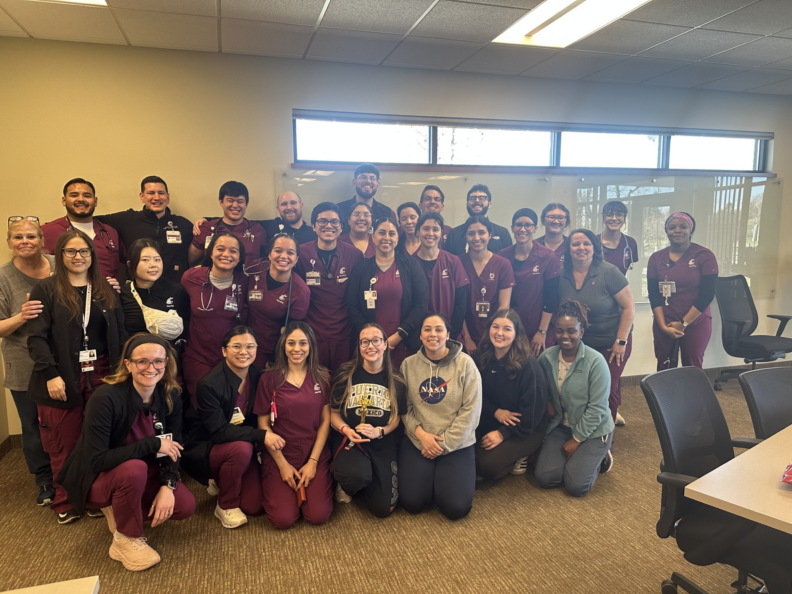
Washington State University College of Nursing students stepped into a fast-paced, high-pressure environment on March 21 during a large-scale Mass Casualty Incident (MCI) simulation hosted on the Pacific Northwest University (PNWU) campus in Yakima, WA.
The full-day exercise brought together nursing students, medical students, law enforcement, and emergency response teams to simulate a complex emergency scenario involving a shooter, hostages, and a surge of critically injured patients. The goal was simple: prepare future health care professionals for real-world crisis situations.
The event was the result of months of planning led by Diana Swayze, BSN, MSN, RN, teaching assistant professor on the Yakima campus, in collaboration with Yakima advisor Mary Gonzalez and community partners.
“This was as real as possible,” Swayze said. “Students worked alongside Yakima police, SWAT, and multiple EMS systems while managing triage and patient care in a busy trauma setting.”
Diana Swayze, BSN, MSN, RN, Teaching Assistant Professor, Yakima.
Hands-On Learning in Real Time
Students were organized into interdisciplinary teams of two to three medical students and two nursing students, pairing junior and senior nursing students together. Each team rotated through four to five scenarios that included trauma, medical, and critical care cases.
27 nursing students participated- 16 from WSU Yakima & 11 students from WSU Tri-Cities.
All semester students participated in the MCI Event. Junior students: 11 & Senior students: 15.
Throughout the day, participants responded to 40 different scenarios. These ranged from gunshot and knife injuries to walk-in emergency cases such as strokes, heart attacks, acute asthma attacks and pediatric emergencies.
The structure of the day mirrored real clinical workflows:
• Full MCI pre-brief
• Nursing-specific skills review
• Simulation scenarios with immediate team debriefs
• Large group debrief at the end of the event
Between scenarios, students reinforced key concepts like triage protocols, trauma response, and communication strategies such as verbal orders and read-back.
Swayze emphasized the level of immersion. “By the end of the day, we told students, ‘you are all real trauma nurses today.’ And they rose to that expectation.”
Commitment Beyond the Classroom
The 8-hour simulation ran from 7 a.m. to 3 p.m. Many students gave up part of their spring break to participate.
Nursing students prepared for the MCI event by reviewing ATI learning system module called “Introduction to Critical Care and Emergency Nursing” with focusing on disaster preparedness and the nursing role. The students reviewed their nursing skills to prepare for the event.
Their effort stood out.
“The students did fantastically,” Swayze said. “This event would not have run as smoothly without nursing.”
The collaboration across disciplines and agencies created an environment where students could apply clinical judgment, build confidence, and experience the realities of emergency care in a controlled setting.
Christina Chacón, academic director and clinical associate professor shared, “[we greatly appreciate] all of those involved in planning and carrying out such a successful learning experience for the students.”
Preparing for What Comes Next
Mass casualty simulations like this are designed to bridge the gap between classroom learning and clinical reality. They expose students to uncertainty, urgency, and teamwork at a level that traditional settings cannot replicate.
For WSU nursing students in Yakima and Tri-Cities, the experience delivered exactly that.
And in the process, it reinforced a core truth: strong patient outcomes in crisis situations depend on preparation, communication, and the ability to act as a team under pressure.
Special Thanks
A special thank you to the faculty, clinical instructors, and staff who dedicated their time and expertise to make this event possible. Their coordination, mentorship, and presence throughout the day ensured a safe, organized, and impactful learning environment for students. From planning and pre-briefs to hands-on guidance during simulations, their efforts were essential to the success of the MCI experience. Faculty and instructors in attendance included Diana Swayze, Tanya Britt, and Kelsie Young, along with support from Mary Gonzalez, WSU Yakima Advisor.