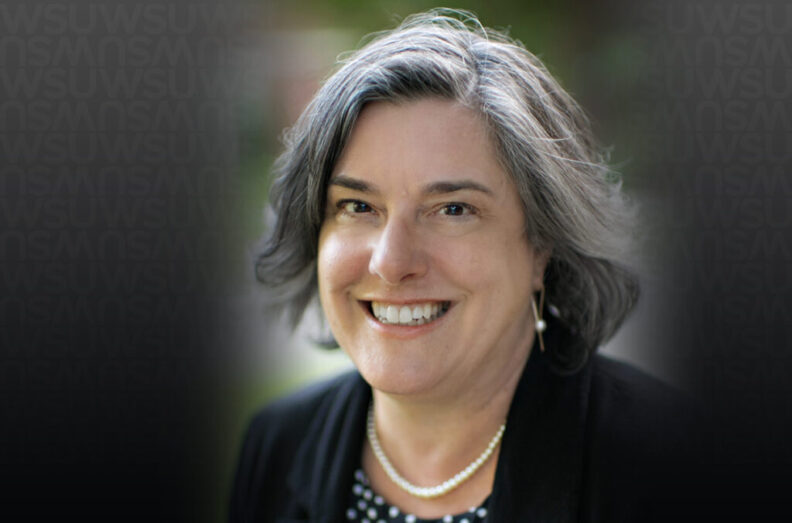
For Dr. Tracy Klein, safe prescribing is not only about knowing when to prescribe a medication. It is also about knowing when not to prescribe, when to taper, and how to help patients avoid harm over time.
Klein, a professor at Washington State University College of Nursing in Vancouver, is a family nurse practitioner, researcher, educator and recently appointed member of the WSU Board of Regents. Across those roles, her work centers on the intersection of public policy, prescribing practices, patient safety and advanced nursing education.
Klein said, “I really enjoy nursing as an applied profession. I never really have to explain why it’s important to do what we do.”
That practical focus has shaped one of Klein’s highest-impact recent projects: her role as a contributing author and nurse practitioner representative on the 2025 national benzodiazepine tapering guidelines developed through the American Society of Addiction Medicine (ASAM). The 18-month effort, funded by the Food and Drug Administration (FDA), brought together national experts to create guidance for clinicians on when and how to taper benzodiazepines, how to assess risk and benefit, how to use shared decision-making, and how to manage withdrawal safely.
Benzodiazepines, including medications such as Xanax and Valium, are commonly used for anxiety, insomnia and some medical conditions. They are generally intended for short-term use, but Klein said many patients remain on them for years.
“They were never approved for people to take them for 40-plus years,” Klein said.
That creates difficult decisions for prescribers. Long-term use can increase risks, especially for older adults, including falls, automobile accidents, cognitive effects and complications when combined with other medications. At the same time, stopping suddenly can be dangerous.
“If you quit a benzodiazepine suddenly, and you’ve been taking it for a long time, you have a risk of seizures and other really significant medical side effects that can land you in the hospital,” Klein said. “So they have to be tapered.”
Before the ASAM guidelines, Klein said clinicians often relied on local practice habits, institutional protocols or limited evidence.
“Believe it or not, there were no national guidelines on this,” Klein said. “Everybody had a way that they might do it.”
The new guideline has already been cited dozens of times since its release. Klein also worked with Emily Brunner, MD, as a curriculum consultant with ASAM staff on a clinician toolkit designed to help providers apply the guidance in practice.
“One of the things that we wanted to do was make sure that we provided information that clinicians could use in their practice, so they felt supported,” Klein said. “This is a very high-impact guideline because it’s the first of its type, and it’s national.”
Klein’s benzodiazepine research extends beyond the guideline. In related studies using Medicaid data, she and collaborators examined what happens after patients start benzodiazepines and how policy can affect long-term use. One study found that 28% of patients starting a benzodiazepine transitioned to longer-term use after 12 months. Other findings linked higher initial strength and larger initial quantities to higher risk.
For Klein, those findings point to a practical lesson for prescribers.
“It takes two minutes to write a prescription,” Klein said. “But it can take a year to taper somebody off.”
That insight carries directly into her teaching. Klein teaches Advanced Pharmacology, Rational Prescribing and Clinical Decision-making in the WSU College of Nursing Nurse Practitioner program. In Klein’s Rational Prescribing course, students work through a complicated patient case involving multiple medications and a medical cannabis card, reflecting the kind of decisions they will face in practice.
“They have to tell me how they are going to adjust this patient’s medications, which are they going to take them off of, why are they going to do it, and in what order,” Klein said. “The students always give feedback about how useful and important this was, and how it wasn’t information they were familiar with before.”
Her current research continues to examine prescribing and patient safety. In collaboration with the Washington State Board of Nursing and the Washington Prescription Monitoring Program, Klein is studying ketamine and esketamine prescribing from 2019 to 2025. Esketamine is an FDA-approved nasal spray for treatment-resistant depression with strict monitoring requirements. Ketamine, an anesthetic drug, is increasingly being promoted by clinics for conditions such as depression and anxiety.
Klein said preliminary findings show a 600% increase in ketamine prescribing during the study time frame, with many fills for Washington patients coming from out-of-state pharmacies, heavy cash payment and non-standard doses or prescribing durations.
“We wanted to know if this is really a problem, and if so, how bad of a problem is it?” Klein said. “And is it a problem for just some kinds of practitioners, or is it a problem for everyone? And how does it impact patients?”
Another project reaches back to the roots of Klein’s nursing career. With support from a WSU Vancouver mini-grant, she is conducting oral history interviews with people who worked in a Portland feminist health clinic from 1979 to 2002. Klein worked at the clinic in 1985 before becoming a licensed health care provider.
“That really inspired me to go to nursing school and become a nurse,” Klein said. “My goal was always to be a nurse practitioner.”
The project explores how feminist health care models helped patients ask questions, understand treatment options and participate more actively in their care. For Klein, that history connects to the same patient-centered questions she wants today’s providers and students to ask: ”What happens if a patient does not take a drug? What are the risks? What are the alternatives? What does the patient understand and value?”
Klein later returned to WSU for her Family Nurse Practitioner preparation and then again for her PhD before joining the faculty. Today, her work spans clinical practice, research, teaching, policy and university leadership.
“I think there just can’t be a bigger impact than the role that we have as nurses,” Klein said.
“People trust us. People share their lives with us. They ask us for information. They ask us for help.”
That trust, she said, is part of what gives nursing its reach.
“There really is no limit to the things that you can do with nursing,” Klein said. “That’s the thing that keeps it really exciting. You can always learn more.”
Klein’s work shows how nursing faculty create impact far beyond one classroom or clinic. They teach future providers, guide safer prescribing, study gaps in practice, inform policy and help patients receive care grounded in evidence, judgment and trust.