For many nurses, the path from clinical practice to the classroom comes with a difficult financial reality.
Nurses who move into full-time academic roles often take a pay cut from clinical care. At the same time, graduate education can be expensive, especially for nurses pursuing the degrees needed to teach at the college level.
The Nurse Faculty Loan Program (NFLP) helps make that path possible.
At Washington State University College of Nursing, the federally funded program supports graduate nursing students who are committed to becoming nurse educators. The funding comes through the Health Resources and Services Administration, or HRSA, and provides loan support for eligible students in graduate nursing programs, including the Master of Nursing, Post-Master’s General Nurse Practitioner, and PhD programs.
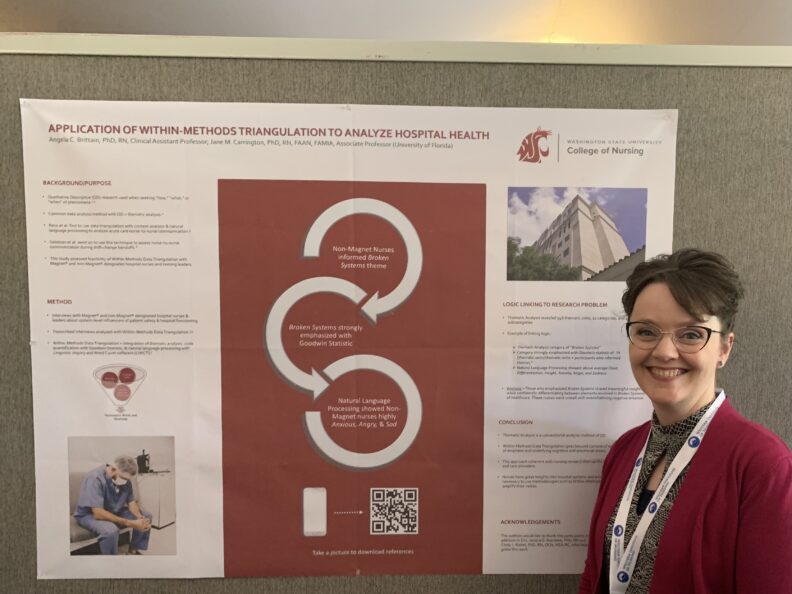
Angela Brittain, PhD, RN, clinical associate professor at WSU College of Nursing in Vancouver, now helps steward the program at WSU. The grant was originally applied for by former faculty member and Interim Dean Mel Haberman, with Gail Oneal, retired nursing clinical instructor, serving as the previous NFLP director.
In plain terms, Brittain said, the program helps build the nurse faculty workforce.
“Accredited schools of nursing can apply for the NFLP funding, and then they are provided with money to essentially make a student loan fund,” Brittain said. “It’s for graduate level only, so students who are in the Master of Nursing, the Nurse Educator track, DNP students who are in the Post-Master’s General track, and then PhD students—any of those who are committed to becoming nurse faculty after graduation—can apply.”
Students who receive NFLP support agree to work as full-time nursing faculty after graduation. In return, a portion of the loan is forgiven for each year they teach. After the first, second and third years of full-time nurse faculty employment, 20 percent of the loan is forgiven each year. After the fourth year, the remaining 25 percent of principal and interest is forgiven, leaving a more manageable 15 percent to repay.
For students who know they want to teach, Brittain said the program can be a deciding factor.
“Anecdotally, I’ve had a lot of NFLP recipients tell me that if it weren’t for the NFLP loan funding, they wouldn’t be able to pursue this graduate education in order to be a nurse educator,” Brittain said. “It’s helping to really make that education accessible in order to boost the number of nurse faculty that we have, not only in Washington state, but really across the nation.”
The need is clear. Nursing programs across Washington and the nation are constrained by faculty shortages. When programs do not have enough qualified faculty, they may have to limit the number of students they can admit, even when demand for nurses remains high.
That makes nurse faculty development a workforce issue with a broad community impact.
More nurse faculty can help nursing programs educate more students. More nursing students can help meet the need for nurses in hospitals, clinics, schools, rural communities and public health settings.
Brittain understands the value of the program personally. Before earning her PhD in Nursing Science from the University of Arizona, she spent about 20 years in patient care. She entered graduate education through a bridge pathway, earning her MSN before pursuing doctoral study.
During her MSN program, she discovered a love for academia.
“When I was in the MSN program, I just kind of fell in love with academia and decided that I wanted to be an educator,” Brittain said. “At the end of that, all the positions that I was interested in required a doctoral degree, so that was the impetus of going back yet again to get the PhD. The NFLP came into play for that PhD program.”
Because many academic nursing positions require doctoral preparation, Brittain continued into a PhD program. She used NFLP support during that process.
The support made a difference.
“It worked beautifully that I was able to, right out of school, start at WSU,” Brittain said. “After the four consecutive years, I had 85 percent of the loan principal and interest forgiven, and had that 15 percent left to pay, which was tremendous. Just a tremendous benefit.”
Brittain has now been teaching for six years. She said she would recommend the program to students who are certain they want to pursue a career in nurse education. It may not be the right fit for someone who is unsure, but for students committed to academia, it can open a door that might otherwise remain closed.
Brittain’s own teaching and scholarship also connect with the larger systems that shape nursing practice. Her research interests include hospital system health, communication pathways, informatics and patient safety. She teaches informatics at the RN-BSN and graduate levels, helping students understand how data are collected, stored, retrieved and used to support safe care.
“I’ve had many, many students tell me that they’re so surprised about how interwoven informatics is into their daily nursing practice,” Brittain said. “They had no idea how much hands-on experience they had with informatics without even realizing it.”
For Brittain, the connection between nursing education, system-level thinking and patient safety is direct. Nurses need to understand how systems work so they can advocate for safer, healthier environments for both patients and health care workers.
That includes electronic health records (EHR), communication pathways and the way decisions are made within complex health care systems.
“Patient safety depends on healthy systems and effective communication,” Brittain said.
“Unhealthy systems negatively impact nurses, perpetuate burnout, and threaten patient safety. Healthy systems are characterized by things like shared governance and effective communication. When decision-making and communication with leadership, colleagues, and patients are bolstered, patient safety is optimized.”
Brittain said the future of nursing depends not only on preparing more nurses, but also on preparing nurses who can teach, lead and improve the systems where care happens.
The NFLP is one tool that helps make that possible.
By reducing the financial burden of graduate education, the program helps nurses move into faculty roles. Those faculty members then help educate future nurses, strengthen academic programs and support health care access in communities across Washington and beyond.
For alumni and donors, Brittain said the message is simple: support for nurse faculty has a multiplying effect.
It helps one graduate student complete a degree. It helps one nurse become an educator. It helps one nursing program build capacity. And over time, it helps more students enter the nursing workforce.
“I think it comes back to making higher education accessible for students who wouldn’t necessarily be able to pursue that higher education otherwise,” Brittain said. “Giving an avenue to get that degree for people who are passionate and committed to pursuing careers in academia—and then that trickle-down effect of having more nurse faculty helps nursing programs in general be able to accept more nursing students, which then in turn helps our communities.”
What is NFLP?
The Nurse Faculty Loan Program is a HRSA-funded program that helps accredited schools of nursing support graduate students preparing for nurse faculty roles.
Recipients commit to work as full-time nurse faculty after graduation. Those who complete four consecutive years of faculty service may receive up to 85 percent loan forgiveness.
The program helps reduce the financial barrier for nurses pursuing graduate education and supports the national need for qualified nursing faculty.