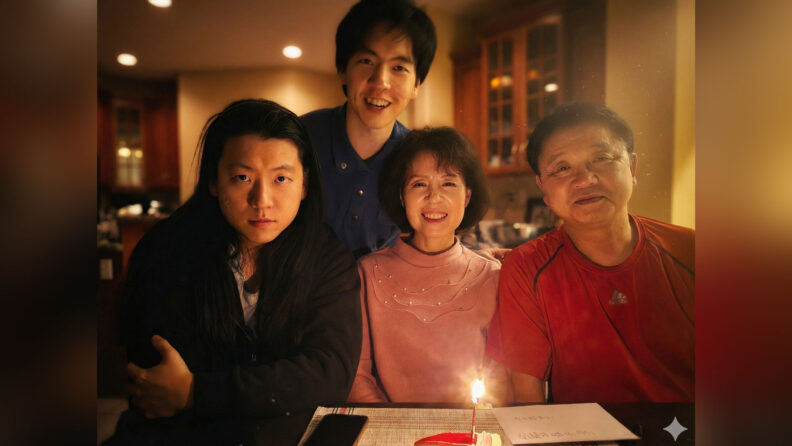
Washington State University College of Nursing RN-BSN graduate Taek Huh, BSN ’25, RN, found more than academic advancement while completing his bachelor’s degree. Through personal hardship, faculty mentorship, and a willingness to seek help, he discovered a deeper understanding of empathy that now guides his nursing practice and his future as a psychiatric mental health nurse practitioner.
Only a few assignments stood between Taek Huh and graduation from Washington State University’s RN-BSN program.
He had spent years working toward that moment. Becoming a registered nurse—and ultimately earning his Bachelor of Science in Nursing—represented a goal he refused to abandon, even after his first two attempts at an RN program didn’t go as he had hoped.
Yet as graduation approached, everything seemed to unravel.
His grandparents in South Korea passed away. His parents traveled home to mourn with family, only to face medical emergencies of their own. At work, he had recently stepped into nursing leadership while balancing full-time responsibilities and a demanding academic schedule.
“I… at that point, was the closest I’ve been to quitting, and… the closest I’ve ever been to graduating as well,” Huh said. “The end of the tunnel was right around the corner, but that’s when it was the hardest part of my life.”
Then one faculty member noticed something others might have missed.
“One of the instructors, Dr. Brittain, checked in on me, asking if I’m doing okay,” Huh recalled. “That’s when I just kind of… spewed out everything.”
That conversation changed the course of his nursing journey.
A Goal Worth Pursuing
Huh’s path into nursing wasn’t straightforward.
His family immigrated from South Korea, where education and hard work were deeply valued. His father, who studied engineering and business, encouraged him to explore nursing after researching careers that offered opportunity and stability in the United States. His mother studied Korean literature, and his brother later graduated from Washington State University with a degree in computer science.
After high school, Huh wasn’t certain what he wanted to do. Following his father’s advice, he became a certified nursing assistant, completed his prerequisites, and enrolled in nursing school.
When those first attempts at an RN program didn’t work out, he chose a different route instead of giving up.
He completed an LPN program, continued building his clinical experience, and never lost sight of becoming a registered nurse. Years later, he earned his RN through Lower Columbia College while simultaneously enrolling in WSU Vancouver’s RN-BSN program.
Looking back, he knows those setbacks became part of the foundation that carried him forward.
“2016 was a tough year for me,” he said. “That’s when I… didn’t make it through the RN program twice.”
Years later, Huh sees those setbacks differently. They weren’t the end of his journey—they were part of it.
“…keep going at it,” he said. “You’re gonna get to your goals.”
Learning While Leading
By the time Huh entered the RN-BSN program, his career was already changing.
He had moved beyond bedside nursing into leadership roles involving staff development, infection prevention, education, quality improvement, and regulatory readiness.
Unlike many RN-BSN students, he wasn’t learning leadership for a future position. He was living it every day.
Lessons in public health became immediately relevant as he worked with county health officials during infectious disease investigations. Coursework in leadership and evidence-based practice directly informed the staff education, interdisciplinary collaboration, and quality improvement initiatives he was leading at work.
“The learning in the BSN program was directly applicable to my job,” he said.
Instead of waiting to apply what he learned after graduation, he was putting those lessons into practice almost immediately.
A Different Kind of Support
While his professional responsibilities were growing, his personal life became increasingly difficult.
The combination of family loss, overseas emergencies, demanding work, and school left him overwhelmed. Assignments slipped behind, and for the first time, finishing the degree no longer felt certain.
Dr. Angela Brittain noticed.
Rather than focusing on missed assignments, she asked a simple question.
Was he okay?
After listening to everything Huh had been carrying, Brittain encouraged him to use WSU’s counseling resources. Jenny Schrock, academic coordinator for the RN-BSN program, helped him navigate deadlines, checked in throughout the semester, and later introduced him to the Psychiatric Mental Health Nurse Practitioner pathway and another student already in the program.
That support mattered.
Until then, Huh admits he carried many of the beliefs he had grown up with.
“I was still just stereotypical… man coming from Korea,” he said, describing a culture where emotions were often expected to remain private and personal struggles were something to overcome on your own.
He decided to try counseling anyway.
“What the heck,” he remembered thinking. “Give it a try.”
It became one of the most important decisions he made.
Learning more about his own mental health—including better understanding his ADHD—and experiencing counseling firsthand reshaped how he viewed himself, his patients, and the profession he loved.
Learning Empathy
Before counseling, Huh believed he understood people.
Looking back, he realizes he often understood behavior without considering what might be causing it.
“My vision was very narrowed down,” he said.
If a coworker arrived frustrated or short-tempered, he assumed they simply needed to be more professional.
Today, his first instinct is different.
He wonders what happened before they walked through the door.
What stress are they carrying?
What am I not seeing?
That same perspective changed how he approached patient care.
“I used to react as, ‘Oh, George is being a grumpy old man again,’” Huh said. “But now I would look at it as… ‘What’s going on?… What’s causing George to have a cranky day?’”
The experience didn’t simply improve his own well-being.
It taught him empathy.
It changed how he communicates with patients.
How he leads coworkers.
How he teaches others.
And ultimately, it changed the kind of nurse he wants to become.
Looking Ahead
After completing the RN-BSN program in 2025, Huh was accepted into Washington State University’s Doctor of Nursing Practice Psychiatric Mental Health Nurse Practitioner program.
His goal is to help address the growing need for mental health providers while reducing the stigma that still prevents many people from seeking care.
He hopes to combine clinical practice with education and community outreach, helping people better understand mental health before they reach a crisis.
Looking back, Huh no longer measures success by promotions or degrees.
Instead, he thinks about the kind of environment he hopes to create.
“When I can foster a home environment where everyone’s laughing and happy and safe… everybody is feeling protected, understood, and happy,” he said.
It’s the same kind of environment he hopes to build throughout his nursing career—one where compassion begins with understanding, and where asking for help is recognized as a sign of strength rather than weakness.