
RN-BSN
Application Deadlines
We encourage you to apply early for scholarships!
Summer Semester
November 19 – May 4
Fall Semester
November 19 – July 6
Spring Semester
July 15 – November 30

Concurrent Enrollment
Are you looking for a way to expedite your path toward your Bachelor of Science Nursing degree?
Read about our Concurrent Enrollment Program and students can attend RN to BSN courses during the summer while in the community college nursing program.

Transitioning from ADN to BSN-prepared RN was significant, and WSU Vancouver provided the perfect platform. The faculty and staff were incredibly supportive, recognizing the value of my prior experience. I’m grateful for the opportunity to further my education and advance my career.
Candance McGill ’24, RN-BSN Graduate
WSU Vancouver
Experience what makes WSU extraordinary!
My experience in the WSU Vancouver RN-BSN program has not been without its highs and lows. Notwithstanding, the priceless knowledge I have accumulated due to the curriculum will further my career in nursing and for that I am forever grateful. One high I would like to share is Dr. Van Son giving me the compliment of my work being worthy of a student in a Master’s program. Those encouraging words made my heart smile.
Tureia Glover ’24, BSN
Transitioning from ADN to BSN-prepared RN was significant, and WSU Vancouver provided the perfect platform. The faculty and staff were incredibly supportive, recognizing the value of my prior experience. I’m grateful for the opportunity to further my education and advance my career.
Candance McGill ’24, BSN
I want to take this singular opportunity to express my deepest gratitude to all the faculty, from the amazing Jenny Schrock and all the other amazing professors who took this journey with us. I will ever be indebted to you and humble for the knowledge [you] gave me. Thank you so much.
RN to BSN Student
There are amazing collaborations with incredible hospitals, fantastic instructors and great potential.
RN to BSN Student
Admission Requirements
UCORE
What are the WSU College of Nursing prerequisites and University Common Requirements (UCORE)?
Students must complete the WSU College of Nursing prerequisites and UCORE. Please note, students with a DTA (Direct Transfer Agreement) degree or a bachelor’s degree in another field are not required to complete UCORE classes.
Note: Students planning to begin the program in Fall must complete all requirements by the end of their Spring term. Students planning to begin the program in Spring must complete all requirements by the end of the Fall Term. (i.e. if you are applying for Fall 2023, requirements must be completed by the end of Spring 2023)
How do I know if my other courses will transfer?
Applicants may send an unofficial transcript to a nursing advisor for feedback to determine whether courses will apply towards the UCORE requirements. They may also reference the WSU Transfer Center website, which is a tool that helps transfer students determine unofficial course equivalencies and request course evaluations. Note that official assessment of transfer course work for prerequisite and UCORE needs is completed at the time of application to WSU.
Nursing Prerequisites
Below is the general list of the College of Nursing prerequisites for the RN-BSN program. For more detailed information of specific course equivalencies, please refer to the lists of common approved transfer institutions’ course work. If there are questions about course work not listed, please contact the Academic Advisor of the campus to which you are applying.
NOTE: If you are graduating with the nursing transfer degree (AN/DTA MRP) it will satisfy all prerequisite/UCORE requirements.
| Course Subject | Semester Credits* | Quarter Credits* | Notes |
|---|---|---|---|
| Human Anatomy & Physiology courses with labs | 8 | 10 | Must include 2 labs in total. Our preference is that you take both courses at the same institution to ensure full coverage of content. If you find that you must explore taking these at differing institutions, please contact your campus advisor to explore if pre-approval will be possible and provide a syllabus for both courses. |
| General Chemistry with lab | 4 | 5 | Courses such as general chemistry 1, or GOB chem, are acceptable. Must include lab. |
| Human Nutrition | 3 | 4 | Sports nutrition is not acceptable. |
| Introduction to Sociology/Social Problems | 3 | 4 | Other social science courses, diversity courses, or medical communication courses may work as well. Please contact an RN-BSN advisor to review options if you have not taken a sociology course. |
| Introduction to Psychology | 3 | 4 | |
| Microbiology | 4 | 5 | Must include lab. |
| Statistics | 3 | 4 | Must include inferential and descriptive statistics. |
*Minimum number of credits required.
Did you take nursing prerequisites at another institution?
Check out our RN-BSN Transfer Guide to see course equivalencies.
Application Requirements
- Have a current, unencumbered Washington state RN license, or be eligible for licensure when program starts.
- Be at junior standing (60 semester hours/90 quarter hours), have a direct transferable associate degree, or have a bachelor’s degree.
- Cumulative GPA of 3.0 or higher in all college coursework.
- Complete College of Nursing RN-BSN prerequisite courses and WSU’s University Common Requirements (UCORE) or equivalent course work. Grades of Pass/Satisfactory, and CLEP scores, may not be accepted. Please contact your nursing advisor for further details.
- Check with your RN-BSN advisor or compare your completed courses at the Transfer Credit Equivalencies website. If you are graduating with the nursing transfer degree (AN/DTA MRP) it will satisfy all prerequisite/UCORE requirements
Please note that an offer of admission is provisionally contingent upon acceptance to the University, satisfactory completion of all academic coursework prerequisite to nursing, completion of all general requirements by the end of the semester prior to beginning the program, and completion of all required onboarding and compliance needs prior to their relevant deadlines.
Program Requirements
Technical Standards
Nursing education requires that the accumulation of scientific knowledge be accompanied by the simultaneous acquisition of skills and professional attitudes and behaviors.
RN-BSN Clinical Passport Requirements
The College of Nursing calls the combination of proof of licensure, immunizations, required trainings (e.g. CPNW Modules), and certifications (e.g., CPR) the “Clinical Passport.”
Required Courses
| Course | Title | Credits | Course Offered |
|---|---|---|---|
| NURS_FPC 360 | Contemporary Nursing | 3 | Offered 1st 8 weeks of the semester. |
| NURS_FPC 400 | Nursing Research & EBP | 3 | Offered 2nd 8 weeks of the semester. |
| NURS_FPC 405 | Nursing Leadership | 3 | Offered Fall – 1st 8 weeks of the semester. |
| NURS_FPC 406 | Nursing Management of the Healthcare Environment | 3 | Offered Spring – 1st 8 weeks of the semester. |
| NURS_FPC 413 | Healthcare Informatics | 3 | Offered 2nd 8 weeks of the semester. |
| NURS_FPC 440 | Population Health Theory | 3 | Offered 1st 8 weeks of the semester. |
| NURS_FPC 463 | Coordination of Care Across Complex Populations | 3 | Offered 1st 8 weeks of the semester. |
| NURS_FPC 465 | Application of Population Health Principles | 3 | Offered as 12-week course in the semester. |
| NURS_FPC 495 | Advanced Practicum | 3 | Offered 2nd 8 weeks of the semester. |
| Electives | 3 | Offered 2nd 8 weeks of the semester. |
RN-BSN Total Required Credits – 30
What is RN to BSN Day?
RN to BSN Day is a signature seminar offered every semester via zoom at Washington State University for all levels of RN to BSN students—whether you’re just beginning your journey or preparing for graduation.
Program Outcomes
- Formulate nursing practice decisions using the foundation of a liberal education and evolving knowledge from nursing science, the biological and behavioral sciences, and the humanities.
- Apply leadership concepts, skills, and decision-making in the provision of high-quality nursing care, healthcare team coordination, and the oversight and accountability for safe care delivery in a variety of settings.
- Integrate reliable evidence from multiple credible sources of knowledge including basic and health sciences to inform practice and make clinical judgments.
- Demonstrate skills in using patient care technologies, information systems, and communication devices that support safety and quality nursing practice.
- Demonstrate basic understanding of the role of nurses in advocating for patients, communities and populations in discussions related to healthcare policy, finance, and regulations.
- Use inter- and intraprofessional communication and collaborative skills to advocate for safe, evidence-based, high quality patient-centered care.
- Demonstrate basic understanding of the role of health promotion, and disease/injury prevention in improving population health across the lifespan.
- Demonstrate the values central to nursing practice including altruism, autonomy, human dignity, integrity, advocacy, social justice, and life-long learning.
- Provide safe, competent, compassionate, ethical, culturally sensitive, and evidence-based nursing care to individuals, families, groups, communities and populations through promotion, maintenance and restoration of health; prevention of illness, and physical, emotional, and spiritual support throughout the life span.
RN-BSN Virtual Capstone Project
Explore the RN-BSN Virtual Capstone Project poster hall from the Washington State University College of Nursing. This collection highlights student capstone work focused on real-world health care challenges, with topics grounded in evidence-based practice. Each project includes a concise abstract and supporting references, offering a quick way to see how students apply learning to practice.
Paying for the Program
What does it cost to attend the program?
Visit the WSU Student Financial Services website for information on tuition and expenses at the program and campus level.
How much does it cost to apply?
Nursing CAS itself will cost approximately $55. You will also have to order official transcripts from everywhere you have attended.
Applicants who are invited to the final step of an interview will be charged approximately $15 in Kira Talent fees.
What support can I get with financial aid?
Please see our Financial Aid page for information on scholarships.
What is the Border Bill as it relates to WSU?
The State of Washington’s Border Bill is a program that allows Oregon residents who live in specified counties to attend WSU Vancouver and/or WSU Tri-Cities part-time (8 credits or less per semester) and pay resident tuition rates for the courses taken through these 2 WSU campuses ONLY. Contact an RN-BSN advisor for details.
| Item | Amount* |
|---|---|
| Current Tuition | WSU System Tuition Rates (PDF) |
| View Tuition and Expenses on the Financial Aid website. Students in the RN-BSN program take variable credits per semester, depending on their course progression plan. The program is 30 credits in total. Plan to work with an academic advisor to determine how many courses you wish to take each semester. Undergraduate full-time is considered 12 or more credits and additional costs do not increase after 12 credits. |
|
| Campus & Student Fees | Please note that individual campuses may have additional annual campus or student fees on top of the base tuition amount. Those are:
|
| Course and Program Fees | We recommend to set aside approximately $70 for the semester that NURS 465 is taken. Amounts are dependent on enrollment in NURS 465. |
| Books | Book costs for the whole program are approximately $1,000. |
| NCLEX License | This charge is for 1 credit of the current tuition amount, above. It is charged your first semester (Fall-start and Spring-start) or second semester (Summer-starts). It transfers in 32 credits, allowing students to be juniors and have enough credits after the RN-BSN program to meet WSU graduation requirements. |
| Equipment | Specific equipment requirements are provided to students upon admission offer. In general, please plan for these approximate costs:
|
| Immunization & Onboarding Requirements | Specific immunization requirements are provided to students upon admission offer. Please also note that some immunizations and requirements are required annually, and pricing will vary depending on individual health plans In general, please plan for these approximate costs:
|
| *Please note costs listed on this page are estimates for budgeting purposes only. This is not a bill. For additional budgeting information, refer to the Financial Services figures. Washington State University reserves the right to increase or modify tuition and fees without prior notice, upon approval by the State of Washington and Washington State University Board of Regents and to make such modifications applicable to students enrolled at WSU at the time as well as to incoming students. In addition, all tuition and mandatory fees are subject to change at any time for correction of errors. | |
Personal budgeting
- Transportation
You will have to travel to different clinical sites, up to 50 miles from the base campus. This may also be before public transport begins, or out of range. This may also be during winter – please be prepared to occasionally drive safely and slowly in icy and snowy conditions. - Computer Needs
If you do not already have a computer, one option is this agreement between WSU and Dell. WSU Nursing IT recommends a Windows computer to ensure familiarity at clinical sites and general compatibility. - Housing Needs
If you are moving to the campus, make sure you are considering rent costs and locations. There are not dorms at any of the Nursing campuses. - Parking (Spokane)
Parking varies at Spokane with two options of lots. Parking at the Tri-Cities campus location is free. - Student Organizations
Optional association with student organizations may have small fees or charges attached.
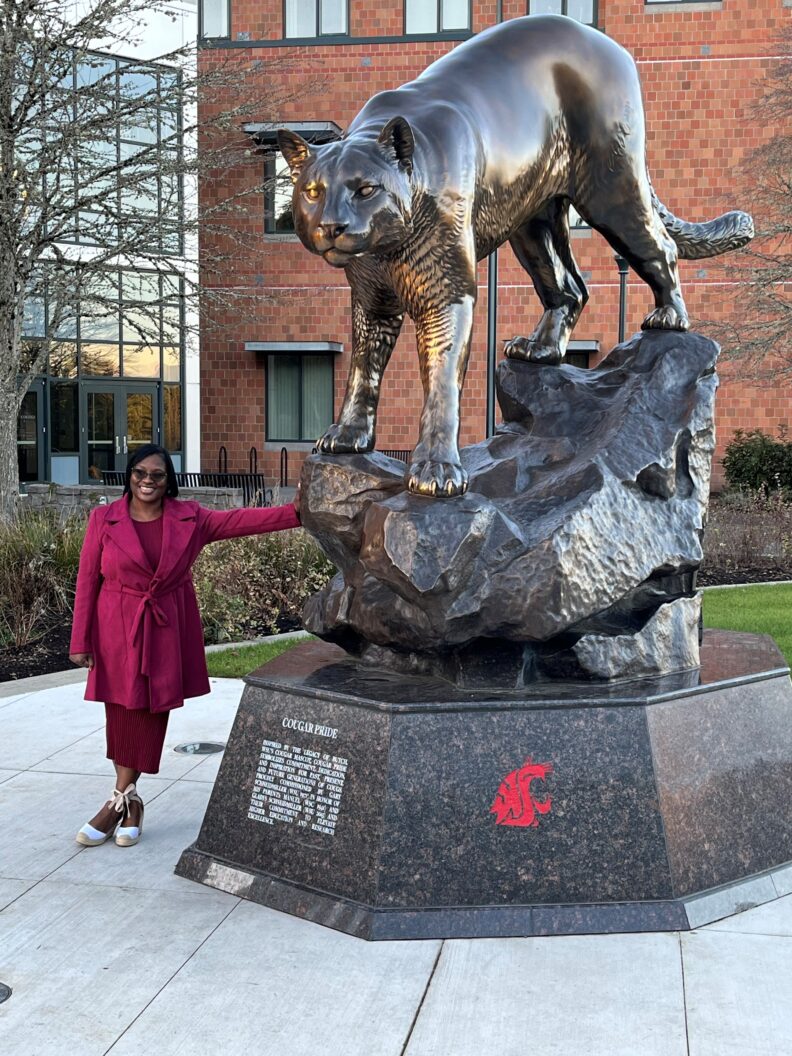
My experience in the WSU Vancouver RN-BSN program has not been without its highs and lows. Notwithstanding, the priceless knowledge I have accumulated due to the curriculum will further my career in nursing and for that I am forever grateful. One high I would like to share is Dr. Van Son giving me the compliment of my work being worthy of a student in a Master’s program. Those encouraging words made my heart smile.
Tureia Glover ’24, RN-BSN Graduate
WSU Vancouver
Frequently Asked Questions
Coursework & Practice Experiential Learning Hours
How long does it take to complete the program? What would my schedule be?
The program is only 30 credits, and most students finish in one year. This would be 12 credits each term for fall and spring, and 6 credits in summer. We also offer a four-semester plan as well as individualized plans of study.
Please contact an RN-BSN advisor. They can explore those various plan options to help you find a plan of study that works for you.
Where do I complete my experiential learning hours?
NURS 465 and NURS 495 courses include practice experiential learning hours under the supervision of the course instructor. These hours are completed doing a community assessment, older adult assessment, and a problem-based project. Students must complete specific portions of these experiences in the State of Washington. If you must move out of Washington state during the program or accept a travel nurse position, contact your RN-BSN advisor and the RN-BSN program director as soon as possible for a plan to complete these course experience hours.
Technology & Program Materials
What computer skills and technology are required?
- Microsoft Office – Word and PowerPoint
- Internet and email
- Canvas software (WSU will provide instruction)
- High-speed internet
Where do I get my books?
Order your books from WSU’s Official Campus Bookstore.
- Spokane Students – select ‘Spokane’ Campus
- Tri-Cities Students – select ‘Tri-Cities’ Campus
- Vancouver Students – select ‘Vancouver’ Campus
- All Students – select ‘WSU online‘ for non-nursing electives available online.
Will I need to wear a uniform for my clinical courses?
No. School uniforms are not required. You will need to wear appropriate attire when out in the community and interviewing for your course projects. Your course faculty can help you with that when you are in the community.
Undergraduate Program Advisors

The Washington State University College of Nursing BSN, MN and DNP programs are accredited by the Commission on Collegiate Nursing Education (CCNE), 655 K. Street, NW, Suite 750, Washington, DC 20001, 202-887-6791.