
Two Washington State University College of Nursing doctoral students are implementing an evidence-based walking program for women in a Spokane residential recovery setting. Supported by Fleet Feet and the Rayce Rudeen Foundation, the project evaluates the program’s effectiveness and feasibility in supporting participants’ mental and physical wellness through exercise.

Leanne McGrath BSN ‘21, based at WSU Spokane, and Elizabeth “Beth” Feustel BSN ‘23, based at WSU Vancouver, are pursuing Doctor of Nursing Practice degrees in the Psychiatric Mental Health Nurse Practitioner (PMHNP) track. Both expect to graduate in 2027.
Fifteen women enrolled in the project, which runs Sept. 15–Dec. 15, 2026. Their goal is to walk at least 6,000 steps per day over five days each week.
Putting evidence into practice
The students developed the program in response to the residential program’s interest in an exercise intervention. They selected walking as an activity that could fit into participants’ daily routines with minimal equipment and limited expense.
The project applies existing evidence into practice, evaluating whether a nurse navigator-supported walking program is practical, acceptable, and sustainable in this setting. The students are also exploring changes in pain, cravings, sleep, depression, and anxiety. Findings will guide local implementation rather than establish results that can be generalized to the public.
A 2025 review in The Lancet Public Health linked higher daily step counts with better health outcomes, with changes in the dose-response pattern around 5,000-7,000 steps for several outcomes. The students selected 6,000 steps on five days per week as a practical program target intended to support sustained participation. [1]
A separate 2025 systematic review and meta-analysis found that exercise interventions were associated with improvements in substance use and cravings. This evidence supports including physical activity in recovery care, while the ideal step target and long-term effects on relapse prevention remain uncertain. [2]
Building on the WSU College of Nursing’s Pain Nurse Navigator project from 2024, funded by a grant from the Washington State Health Care Authority, McGrath and Feustel have broadened the navigator role to support mental and physical wellness. They provide encouragement and guidance as participants work toward their goals and record their progress.
The team includes faculty advisor Dr. Shelley Geil and agency advisor Dr. Fionnuala S. Brown, with research guidance from Dr. Marian Wilson and Ross Bindler, PharmD.
Community partners make participation possible
Fleet Feet in Spokane, WA, donated new running shoes for all 15 women and coordinated individual fittings. Owners Wade and Julie Pannell and outreach coordinator Suzanne Mosman supported the partnership. The business also offered access to walking and running groups without participation fees and plans to provide a gift to each participant upon completion.
Suzanne Mosman, Outreach Coordinator at Fleet Feet PNW said, “we believe the right footwear can make a big difference in helping people feel their best and reach their goals. We’re passionate about supporting our community and partnering with programs that encourage people to get outside, stay active and keep moving!”
A $5,000 grant from the Rayce Rudeen Foundation supports step-counting watches, tracking materials, workbooks, and other supplies, as well as project-related travel. The workbooks include coloring pages and activities focused on mental health.
Learning what supports engagement

Regular participant contact has emerged as an important part of implementation. McGrath described a high volume of step tracking logs being submitted early at the start of the program, when the PMHNP students were on site. Submissions seemingly declined after that point; however, a backlog of additional tracking logs were turned in by the participants during subsequent visits by McGrath.
“The more contact the better,” McGrath said.
That pattern helps the team consider how to support participation and collect records consistently. Delayed log submissions alone do not establish that participants walked less.
The students plan to assess changes in anxiety and depression symptoms, pain, sleep, and substance cravings. Final outcomes have not yet been analyzed.
Planning for continued use
For McGrath and Feustel, who are both in long-term recovery from substance use themselves, the project also has personal significance. Their work brings lived experience together with nursing education to support women working toward their own wellness goals.
The project has reinforced the importance of regular contact, encouragement, and practical support. By preparing materials that future nursing students can use, they hope to sustain the walking program and help more women incorporate physical activity into their recovery.
WSU is also exploring a clinical placement relationship that could support continued student involvement, though discussions remain in the early stages.
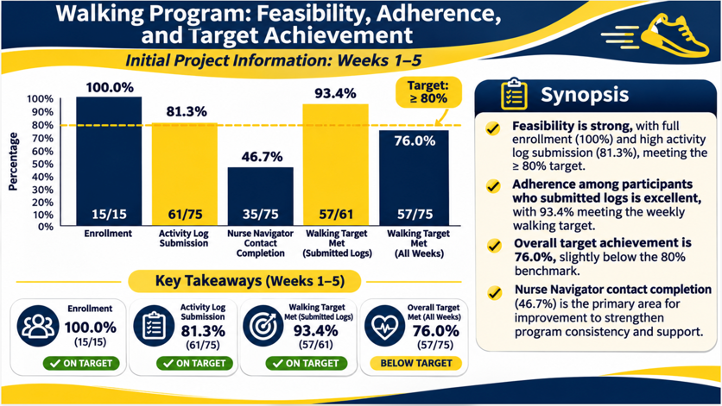
Full Description of the Walking Program chart
A research slide titled “Walking Program: Feasibility, Adherence, and Target Achievement” summarizes the first five weeks of the program. A bar chart on the left uses a 0% to 100% scale and a dashed line to mark the 80% target. From left to right, the five bars show:
- Enrollment among eligible participants reached 100% (15 of 15).
- Activity log submission reached 81.3% (61 of 75 expected logs).
- Nurse navigator contact completion reached 46.7% (35 of 75 expected contacts).
- The walking goal was met in 93.4% of participant-weeks with a submitted log (57 of 61).
- The walking goal was met in 76.0% of all participant-weeks (57 of 75).
The key takeaways row below the chart marks enrollment, activity log submission, and walking goal achievement among weeks with submitted logs as on target. It marks overall walking goal achievement as below target. The synopsis on the right highlights nurse navigator contact completion as the lowest measure and an opportunity to improve program support.
References
[1] Ding, D., et al. (2025). Daily steps and health outcomes in adults: A systematic review and dose-response meta-analysis. The Lancet Public Health, 10(8), e668–e681. https://doi.org/10.1016/S2468-2667(25)00164-1 back to source
[2] Carlson, H. N., Smith, M. A., & Strickland, J. C. (2025). The effects of exercise interventions on substance-use outcomes: A meta-analytic and systematic review. Experimental and Clinical Psychopharmacology, 33(5), 430–438. https://doi.org/10.1037/pha0000785 back to source
Additional references
Kaleth, A. S., Slaven, J. E., & Ang, D. C. (2014). Does increasing steps per day predict improvement in physical function and pain interference in adults with fibromyalgia? Arthritis Care & Research, 66(12), 1887–1894. https://doi.org/10.1002/acr.22398
Salem, B. A., Gonzales-Castaneda, R., Ang, A., Rawson, R. A., Dickerson, D., Chudzynski, J., Penate, J., Dolezal, B., Cooper, C. B., & Mooney, L. J. (2022). Craving among individuals with stimulant use disorder in residential social model-based treatment—Can exercise help? Drug and Alcohol Dependence, 231, 109247. https://doi.org/10.1016/j.drugalcdep.2021.109247
Verbrugghe, J., Reneman, M. F., Cunningham, C., Ciccone, D. K., Budzisz, A., Kocot-Kępska, M., Malliou, N., Vaegter, H. B., & Meeus, M. (2026). Walking for chronic pain: Why it matters, what we know and how to get started: A position paper from the European Pain Federation (EFIC) ‘On The Move’ Task Force. European Journal of Pain, 30(9), e70398. https://doi.org/10.1002/ejp.70398