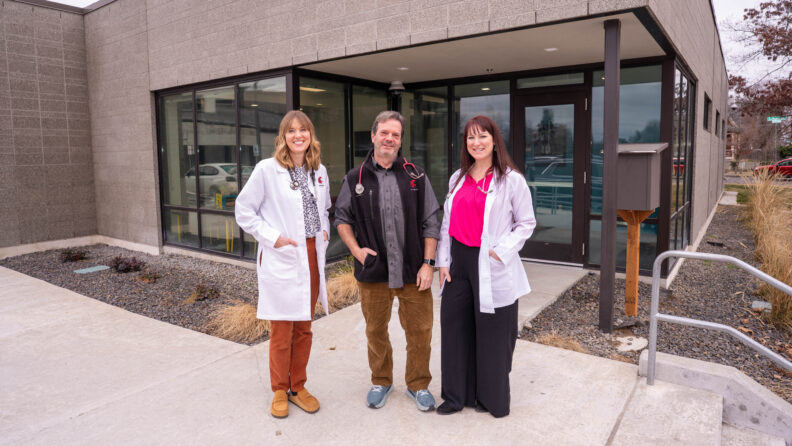
When WSU Health Logan Family Clinic was previewed in last year’s Impact Report, it was still a developing idea: a community-based clinic that could bring care closer to students, families and residents in Spokane’s Logan neighborhood.
In March 2026, that idea became a place of care.
Located inside Logan Elementary School, WSU Health Logan Family Clinic is operated by WSU Health, the university’s academic health network, in partnership with Spokane Public Schools. The clinic provides a new access point for primary care in a familiar setting, helping reduce barriers that can make it difficult for families to keep appointments, including transportation, work schedules, and time away from school.
Lisa Madden, a WSU Health provider and nurse practitioner at WSU Health Logan Family Clinic, said the clinic was created to improve access to primary care for students, families and residents in the surrounding neighborhood. By placing the clinic inside Logan Elementary School, WSU Health and Spokane Public Schools are making care available in a setting families already know.
“Schools are where a lot of people are dropping off their children,” Madden said. “People feel comfortable with schools. This clinic is really right in the middle of a neighborhood. I’m looking out the windows and I can see houses and people walking by, walking their dogs, and they see us. I think it’s a very convenient location and also a safe-feeling place for people to come and seek care.”
In its early months, the clinic has focused not only on providing care, but also on introducing itself to the community. Providers have seen patients for sick visits, well-child visits, preventive care, medication needs, vaccines, women’s health, skin conditions, asthma, abdominal pain, and testing for illnesses such as strep or mono.
“These first few months, I think, really are about letting people know that we’re here, introducing ourselves in the community, trying to build trust,” Madden said. “Most clinics, it just takes time for families to learn that we’re here and to understand that we can care for them: primary care, urgent care, whatever they need.”
Melissa Bocardo, WSU Health practice manager, said the clinic is steadily building visibility and trust in the neighborhood while seeing patients with significant health needs.
“Even though our patient flow has been slow, we have seen a high rate of medically complex patients,” Bocardo said. “I see this as an indicator of why our presence in the community is critical. Individuals need health care, but due to a variety of barriers, they have not been able to access it. WSU Health wants to be a part of the solution.”
That access can help families address needs before they become more serious. Madden said one recent patient had a gap in health care and had not been seen for a few years. The patient had tried to schedule elsewhere but could not get an appointment until September.
“Being able to come here and have an appointment right away was amazing,” Madden said. “She was super appreciative. People are just learning why we’re here and are surprised at what we can do for them when they’re here.”
Leah Powell, a WSU Health provider and faculty member with the WSU College of Nursing, said the clinic is also creating more access for patients covered by Medicaid, especially as other primary care practices may limit how many Medicaid patients they can accept.
“We’re another clinic that has opened and has more appointment availability for Medicaid patients,” Powell said. “By opening Logan, we now have a whole other set of spaces to take those patients in.”
Powell said availability and proximity have already made a difference.
“Proximity was a huge thing,” she said. “We’ve had several people come straight from Logan, adults, who are like, ‘I need to be seen right now. I’ll just pop over there.’”
The clinic is also helping families with vaccines, an important need in a school-based setting.
“We’re getting better at having vaccine availability, and that’s super important, being attached to an elementary school for compliance, especially since national rates have decreased after COVID,” Powell said. “Hopefully, long term, this will help bring those numbers back to where they should be.”
The clinic also reflects the mission of WSU Health, the university’s academic health network, which connects clinical care, education, and community partnership. That mission is supported by WSU’s health sciences colleges and faculty, including the WSU College of Nursing and the Elson S. Floyd College of Medicine.
Across WSU Health’s broader primary care services, including Range/WSU Health, providers recorded more than 1,570 patients and more than 2,360 visits over the past fiscal year. Those numbers reflect overall WSU Health primary care activity, not Logan-specific clinic volume.
For the College of Nursing, WSU Health Logan Family Clinic offers a learning environment where future nurses can see how family needs, access, prevention and trust shape health care. The clinic gives students a closer look at how social drivers of health affect families and how primary care can reach people earlier, closer to where they live, study, and work.
“Having students come in really gives them a feel for the importance of the community, how important it is for the community to trust their provider and have access,” Madden said. “I’m pretty excited that our new students are going to have this experience with such a small clinic, but a larger community.”
[INSERT QUOTE FROM ANNE MASON ABOUT HOW THE COLLEGE OF NURSING SUPPORTS WSU HEALTH’S CLINICAL AND EDUCATIONAL MISSION.]
As WSU Health looks ahead, leaders are exploring opportunities to expand services, including behavioral health and possible telebehavioral health options. Bocardo said WSU Health also expects clinic traffic to grow during the 2026–27 school year as the clinic partners with Logan Elementary to promote vaccines, sports physicals and general primary care.
“Over the next year, I would love to see lots of growth,” Madden said. “I would love to fill that gap, trying to help families with chronic disease, preventive care and well-care appointments. I would love to see the ease and convenience of this clinic become very normal for this population.”
Madden said behavioral health could also help the clinic support the whole person.
“Mental health really is such a big piece of health, not just physical health,” Madden said. “Adding that and having access for counseling and other resources, I’m hoping that’s really going to be a lot of help.”
Powell said telehealth can also expand access when used within appropriate guidelines and alongside in-person care.
“You should have a face-to-face [visit] before you shift into consistent telehealth appointments,” Powell said. “But if the rules are there and the guidelines are there, let’s utilize it. It’s just even more access to care.”
For Madden, the clinic’s future is tied to becoming a trusted part of everyday community life.
“I would love to see lots of growth,” Madden said. “I would love to see the ease and convenience of this clinic become very normal for this population.”
About WSU Health Logan Family Clinic
Located inside Logan Elementary School, WSU Health Logan Family Clinic is operated by WSU Health in partnership with Spokane Public Schools. The clinic is open year-round and provides primary care for students, families, and residents in the Logan neighborhood.
Care is provided by WSU Health providers connected to WSU’s health sciences education mission, including Leah Powell, FNP; Lisa Madden, nurse practitioner; Sarah Fincham, interim associate dean of academic affairs in Spokane, director of faculty practice and post-master’s nurse practitioner; and Sam Schneider, MD, with the Elson S. Floyd College of Medicine.
Services include sick visits, well-child visits, preventive care, vaccines, medication support, women’s health, testing for common illnesses, chronic illness management, and referrals when more specialized care is needed.