For nearly 20 years, Zibby Merritt, MN ’19, BSN, built her career in labor and delivery.
“It was what I was born to do,” she says. “There’s nothing that beats being there in that moment when a baby is born and knowing you helped make that magic happen.”
Her nursing journey began at a milestone moment. Merritt earned her BSN in 2001, graduating just days after the birth of her first son. “He was ten days old,” she says. “I graduated with him in a Baby Björn front pack.”
Labor and Delivery was her dream job. And yet, over time, Merritt began to see the limits of what one nurse could influence from a single bedside.
“I’ll never not want to be a labor and delivery nurse,” she says. “But I also started asking how I could make an impact beyond one shift, one unit, one hospital.”
That question led her back to school—and ultimately to the Master of Nursing program at Washington State University College of Nursing.
A Career Shaped by Teaching and Mentorship
Teaching was always woven into Merritt’s nursing career. She precepted new nurses, supported practicum students, and taught childbirth education. Leadership roles that involved managing people, however, never appealed to her.
“I hated being in charge,” she says. “I didn’t like the stress of it. But I would precept anyone who walked through the door.”
When a nurse educator role opened at Deaconess Hospital, colleagues encouraged her to apply. The catch was clear. To move into education, she needed a master’s degree.
At the same time, Merritt was juggling work, family, and teaching at multiple institutions. She hesitated.
“I had three sons. I was working. I thought, there’s no way.”
Mentors stepped in. One encouraged her to apply for a teaching assistantship through WSU.
“They make it flexible,” Merritt recalls being told. “They make it easy. And you actually get paid when you’re teaching.”
That support mattered.
“I’ve just been so blessed in my career to stumble into incredible mentorships,” she says. “That’s the thing about nurses. They’re quality people. They’re smart. They’re deeply committed to the profession and to each other.”
That early support shaped more than her path through graduate school. Merritt says the opportunity she received through WSU created a sense of loyalty and gratitude that stayed with her long after earning her degree. That commitment led her to continue teaching part time as an adjunct obstetric clinical instructor for more than seven years, sharing her love of labor and delivery nursing with the next generation of students at Washington State University College of Nursing. “My master’s allowed that opportunity,” she says. “And I truly treasured it.”
Choosing the MN to Open Doors
Merritt earned her Master of Nursing in 2019—graduating the same year her son graduated from high school. “We graduated together again,” she says. “It was this full-circle moment.”
Her decision to pursue the MN was never financial. Instead, the MN gave her options.
“I didn’t do it for money. I did it to open more doors,” she says. “It allowed me to understand that if one role didn’t work, I could pivot. That mattered.”
The degree also positioned her for opportunities she didn’t initially anticipate, including research, publishing, national presentations, and system-level nursing roles.
“At a certain level, beyond the bedside, it’s expected,” she says. “Having a master’s becomes part of the language.”
The WSU Difference: Learning to Think Bigger
Merritt is candid about why she chose WSU over fully online programs.
“A lot of my colleagues went through online master’s programs,” she says. “They’re cheaper. They’re flexible. There are perks.”
What WSU offered was different.
“It was a purposeful hybrid format where I was with people,” she says. “I made connections. I found mentors. I would not have had that experience otherwise.”
She points to faculty who shaped her development.
“These were real women—pioneers—doing things I aspired to do,” she says. “Seeing that in real life changes what you believe is possible.”
The program also pushed her beyond task-based nursing.
“I always critically thought,” she says. “But I didn’t critically think big.”
Graduate coursework forced her to look at systems, population health, and evidence in new ways.
“Nursing is one element of a much bigger picture,” she says. “The program blew that open.”
Research That Changed Her Trajectory
Merritt’s thesis focused on substance use disorder in pregnancy. With faculty encouragement, that work didn’t stop at graduation.
“I didn’t even know publishing was an option,” she says. “But I had mentors who said, ‘We can do this.’”
Her thesis was published in a peer-reviewed journal. That led to poster presentations, additional research projects, and ongoing scholarly work.
“It taught me that research is doable,” she says. “And that it’s okay for nurses to ask why.”
She’s direct about the danger of tradition without evidence.
“That’s the way we’ve always done it—that’s the kiss of death in nursing,” she says. “It’s 2026. We can’t practice that way anymore.”
A ‘Unicorn’ Role in Obstetric Care
Today, Merritt serves as an Obstetrical Nurse Specialist for seven birth centers across Washington at MultiCare Health System.
She describes the role as “a unique problem-solving, consultative role.”
“I hear what’s happening in real life and what the ideal evidence-based state should be,” she says. “My job is helping align the two—while advocating for nurses and patient birth experiences.”
She works across departments, collaborating with nurse educators, physicians, legal teams, data analysts, and quality leaders. She leads clinical pathways focused on high-risk areas such as perinatal sepsis, postpartum hemorrhage, opioid use disorder, and severe hypertension.
“It’s my whole job,” she says.
Despite being a senior leader, she manages no direct reports.
“I love leading work,” she says. “I don’t love managing people.”
Immediate Return on Investment
For Merritt, the return on her MN was immediate.
“Immediately,” she says. “The first classes helped me think differently about my job and made me better at it.”
While her tuition was covered through teaching, the real value came through access—to research, peers, mentors, and opportunity.
“I had access to people who believed I could take the next step,” she says. “That matters.”
Advice for Nurses Considering Graduate School
Merritt is candid when nurses ask whether graduate school is realistic.
“You probably are busy,” she says. “I’ve never met a nurse who isn’t.”

For her, the question isn’t whether life slows down. It’s whether the timing is right.
She explains it with an image that still sticks with her.
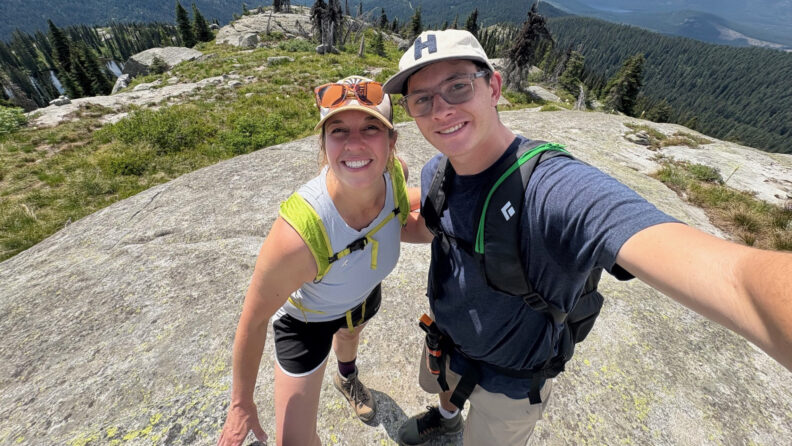
“You know when you go for a hike,” she says, “and you’re like, that was beautiful, I really loved it. Then you take off your backpack and you’re like—heavy.”
“I loved having that backpack on the whole time. It was beautiful. But it would’ve been easier without it.”
That’s where she is now. Walking around. Hiking. Enjoying balance.
“If you asked me to put the backpack back on today, I could do it,” she says. “I could. But I don’t miss it.”
Graduate school, she says, is like choosing the right hike at the right moment.
“There are times in your life where you say, no, I’m not going up a mountain. I’ve got young kids. I’m working nights. This is not the chapter.”
And then there are other times.
“When you’re like, okay. I might need an extra bottle of water. This is going to be hard. But when I get up there, I want to be grateful I made the climb.”
That’s the decision she encourages nurses to make honestly.
“Can you put on the backpack for this chapter [in your life]?” she asks.
“And when you take it off, can you be glad you did?”
Graduate school required grit. Less sleep. Fewer distractions. Clear priorities.
“But it was finite,” she says. “And it was worth it.”
She cautions nurses not to pursue a master’s for the wrong reasons.
“If you’re doing it just for money, don’t do it,” she says. “If you’re doing it because you want to explore, to grow, to find your next chapter—that’s different.”
One Chapter at a Time
Merritt still considers labor and delivery her dream job.
“I’ll never not want to be an L&D nurse,” she says.
Her career, like nursing itself, continues to evolve.
“Nursing is a novel,” she says. “You take one chapter at a time. You don’t reread the last one. You keep going.”
She pauses, then adds:
“You didn’t write the book. But if you trust the author, the next chapter might be even better.”
About the Master of Nursing Program
WSU’s Master of Nursing (MN) program prepares baccalaureate-prepared nurses to move into leadership and education roles that shape how care is delivered. Students choose between two paths: Nurse Educator, focused on teaching, curriculum, and workforce development in academic and clinical settings, or Clinical Systems Leadership, centered on improving care delivery through leadership, quality, data, and operations. Graduates move into faculty and clinical educator roles, health system leadership positions, and administrative or quality improvement careers across private, state, and federal health systems.
