
When Kim Hoover, BSN ‘25, RN first started college in 2010, she was pursuing her nursing prerequisites.
“I’ve always had an interest in health science, and kind of liked the amalgamation of nursing that is bioscience, and then also the humanities portion of it.”
Life shifted. She graduated from Washington State University with a degree in Human Development instead, and spent 10 years working in payroll and HR.
But nursing never left her mind.
“I decided that I wanted to give nursing another shot.”
She took a job as a CNA with Legacy Health while attending Clark College. She loved the field. Through Clark’s Concurrent Enrollment Program, she entered Washington State University’s RN-BSN pathway on the Vancouver campus and graduated in December 2025.
Going Back to School with a Small Family
Hoover returned to school as a non-traditional student. She was working full-time at a corporate veterinary practice. Her twins were two years old. Her oldest was five years old.
She said, “Trying to see if I could swing that, and then also knowing that nursing is a very rigorous program… trying to see if I had basically what it took as an older student to go back and kind of keep up.”
She had doubts.
What helped?
Her support system.
“My in-laws are wonderful people… my mother-in-law saved my bacon numerous times.”
She and her husband built what she calls “a solid foundation and teamwork” to manage schedules. He works full-time as well.
There were tight moments.
“I definitely felt the pinch on the schedule.”
But quitting was never on the table.
“I just decided that failure wasn’t necessarily an option for me.”
The Roadmap That Changed Everything
Hoover credits much of her clarity and momentum to her WSU advisor in Vancouver, Jenny Schrock.
“She was one of the reasons I actually stuck with WSU for the entirety of the program, instead of transferring out.”
During concurrent enrollment, Schrock created a semester-by-semester roadmap outlining exactly what courses Hoover would take and when.
“I would go back to that sucker so many times.”
“It was just very concrete… I never felt like there was a gray area of what I was supposed to be doing.”
That structure mattered during a season of life filled with work, parenting, and academic pressure.
“She made it just absolutely seamless.”
What the BSN Changed
Earning her BSN had an immediate impact.
At work:
- A percentage pay differential for holding a Bachelor’s degree
- Future eligibility for nurse educator roles
- Fewer barriers if she ever decides to leave Legacy Health
“It gives me more opportunity… I know that that’s one less hurdle I [must] overcome.”
It also changed how she practices.
“I feel more confident.”
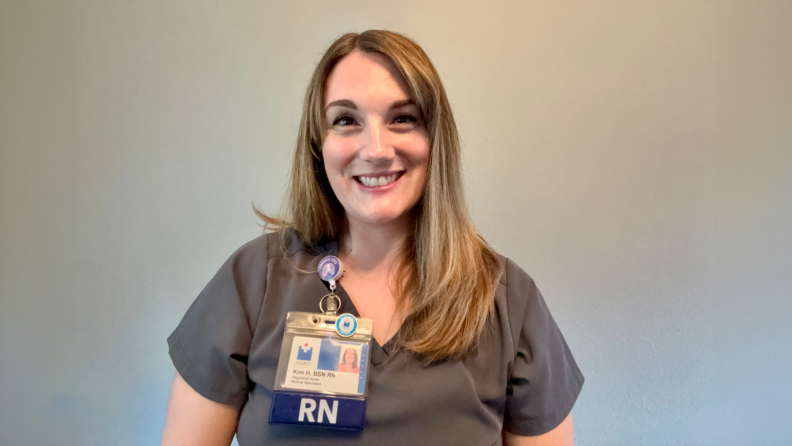
At the beginning of 2026, Hoover had a patient notice that her name badge still didn’t reflect the new BSN credential.
“He was like, ‘are you gonna go back? You need to go back’. And I was like, I actually just finished.”
“He gave me a high five. He’s like, ‘good for you!’”
She says it gives patients peace of mind. It also strengthened her ability to evaluate evidence.
When a patient presents with something complex or atypical, she asks:
Has this intervention been studied?
Is this current best practice?
What does the latest evidence say?
The RN-BSN program gave her the tools to search for reliable sources, evaluate the quality of information, and apply it appropriately.
“Knowing what I’m looking for… is this evidence-based? What am I looking at?”
When discussions happen on the unit, she feels more confident engaging in them.
“I hear what you’re saying… but this is evidence-based because of XYZ now, based on further research.”
For Hoover, the BSN didn’t just add letters after her name. It strengthened her ability to back up patient care decisions with current evidence-based research. Healthcare changes quickly. The RN-BSN gave her tools to keep up.
“I’ll never know everything about everything, and that’s okay.”
Looking Ahead
When asked about her future plans, Hoover said, “I would still see myself at bedside.”
Long-term, she’s interested in becoming a unit nurse educator.
“Watching how others educate other nurses… I think would be an interesting thing to get into.”
For now, her focus is clear:
“Honing my practice and making sure that I’m safe, effective, and then a great resource for the team.”
Concurrent Enrollment: ADN + BSN, Seamlessly
WSU’s Concurrent Enrollment Program allows students to begin BSN coursework while completing their Associate Degree in Nursing at a partner college.
Students receive:
- A semester-by-semester roadmap
- Dedicated advising
- A smooth transition from ADN to BSN
- No guesswork about next steps
As Hoover shared, “I never felt like there was a gray area of what I was supposed to be doing.”
Advice for ADNs
If you’re finishing an ADN and unsure whether to continue:
“Go for it. There’s no downside to it. It will only help you in the long run.”
Her strongest advice?
“Especially if you are just fresh out of your ADN program, while your brain is still in that mode for school, just do it. Tackle it. You’re primed for it.”
She recently spoke with a critical care nurse who now must return for a bachelor’s degree to pursue certification.
“That is one of my things that I do not regret, is just rolling right into it.”
What She’d Tell Herself if She Could Go Back in Time?
Front-load the major class projects earlier. Especially practicum and large theory assignments.
“I definitely felt the pinch come November.”
But beyond strategy, she offered herself some reassurance:
“You’re gonna be okay. This is scary, but it’s gonna be okay.”
And for working nurses wondering if they can handle it?
Hoover’s story makes the answer clear. Yes!
Advance Your Nursing Career with a BSN from WSU
Washington State University’s RN-BSN program is designed for working registered nurses who want to build on their experience and expand career opportunities. The program is fully online, flexible for working schedules, and supported by dedicated advisors who help students stay on track from start to finish. Many nurses complete the program while balancing work, family, and other responsibilities. A BSN can open doors to leadership roles, specialty practice areas, and graduate education while strengthening skills in evidence-based patient care.
