The Washington State University (WSU) College of Nursing is excited to announce the re-launch of its redesigned Master of Nursing (MN) program.
Designed for baccalaureate-prepared registered nurses, the one-year, hybrid-format MN program offers two specialty tracks: Clinical Systems Leadership and Nurse Educator. Students benefit from flexible online and hybrid coursework combined with in-person practicum experiences in their local communities. There is no requirement for on-campus attendance for coursework.
The MN program is available at WSU Spokane, WSU Tri-Cities, WSU Vancouver, and WSU Yakima campuses, serving nurses licensed in Washington, Idaho, and Oregon. Practicum hours must be completed in the catchment area of the campus of registration.
“I chose WSU College of Nursing for its strong academic reputation and the flexibility of its online program, which allowed me to successfully balance work, family, and self-care. What I enjoyed most were the opportunities for interprofessional collaboration with students and the incredible professors who created positive, engaging learning environments while challenging me to grow through scholarly rigor.”
– Magdalena Stark, CougNurse ’23
Graduates will be prepared to lead healthcare system improvements, or educate the next generation of nurses, at a time when demand for advanced-degree nurses is growing rapidly. Washington State Board of Nursing requires all nursing faculty to hold a graduate degree in nursing, current data on nursing faculty identifies a workforce where over 40% are age 51 or higher and the vacancy rate of faculty positions is 13%. Per Washington Center for Nursing’s supply and demand forecast, the shortage of registered nurses persists through at least 2030.
In discussions with community advisory groups across the state about program needs, one of the areas of concern was the limited experience of nurse leaders. When state advisors responded to questions about the ideal Master of Nursing degree, they specifically requested focused education in quality care metrics and patient safety, and systems leadership. The Bureau of Labor Statistics projects that employment for medical and health services managers, which includes nurse executives, will grow approximately 32% from 2020 to 2030, significantly faster than the average for all occupations.
Applications are being accepted for the next cohort beginning on May 15, 2025.
Final Application Deadline:
Fall entry is June 15, 2025.
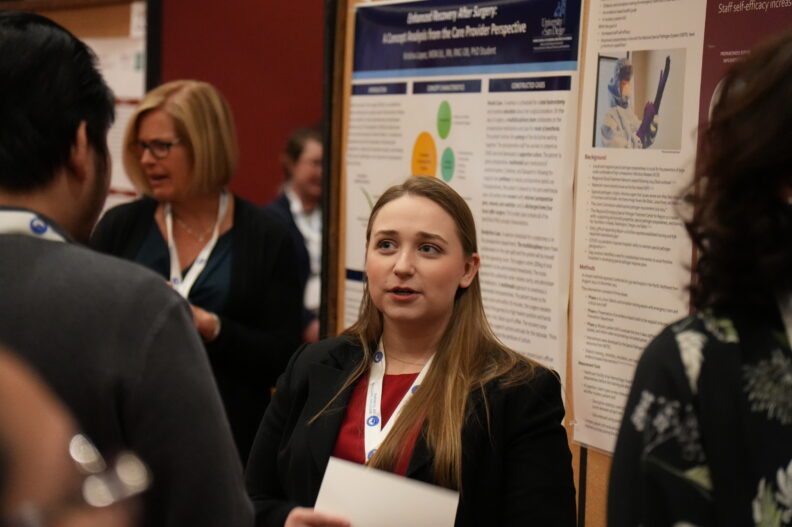
PHOTO: McKenna Freed ’25, presenting her research poster, Increasing Special Pathogen Preparedness at a Frontline Hospital: A Quality Improvement Project, at the 2025 Western Institute of Nursing (WIN) Conference in Spokane, WA.
