
Post-Master’s General Nurse Practitioner
(PMG)
Application Deadlines
Admission to the DNP program is once per year, starting in August for the Fall semester. For example, applying by the January 15 or March 15 deadline means applying to start that following August.
Post-Master’s General (PMG)
Applications Open: August 15
Priority Deadline: January 15
Final Deadline: March 15
Applying by the priority deadline ensures that a decision will be awarded to applicants within 2 months.
Additional spots and decisions are possible after the final deadline.
Admission Requirements
Education Requirements
- Post-master’s General DNP applicants must have a bachelor’s degree in nursing or another field from a regionally accredited higher education institution AND:
- A master’s of nursing degree with an advanced practitioner (NP) direct care focus. This degree must be from a program accredited by either the Commission on Collegiate Nursing Education or the National League for Nursing.
OR - A graduate nurse anesthesia (CRNA) degree from a program accredited by the Council on Accreditation of Nurse Anesthesia Educational Programs of the American Association of Nurse Anesthetists.
OR - A graduate nurse midwifery (CNM) degree from a program accredited by the American College of Nurse Midwives Accreditation Commission for Midwifery Education.
- A master’s of nursing degree with an advanced practitioner (NP) direct care focus. This degree must be from a program accredited by either the Commission on Collegiate Nursing Education or the National League for Nursing.
- A minimum cumulative GPA of 3.0, comprised of all college coursework ever taken.
- Official transcripts from all previous college work.
- If your previous institution is ungraded, or uses a grading scale atypical of a 0-4.0 GPA range, please reach out to an advisor at grad.nursing@wsu.edu. They can provide you more specific and individual information about applying with your educational history.
Practice & Professional Requirements
- Students must hold a current, unencumbered RN license in the catchment area of their campus. That includes Washington (all campuses), Idaho (Spokane campus), and/or Oregon (Vancouver campus). Compact/MSL licenses are acceptable provided they are multi-state with Washington (and Oregon or Idaho if residing near a state border).
- Please note: you will need to be licensed in one of these states before the start of your first semester.
- Every effort is made to place you in a location which is convenient to you with a schedule that works with your current schedule; however, travel and adjustments to your schedule are often necessary.
- If you live in the greater Vancouver/Portland area, it is highly recommended that you hold a current and active license in both Oregon and Washington to open placement opportunities.
- If you live in the greater Spokane Valley area, it is highly recommended that you hold a current and active license in both Idaho and Washington to open placement opportunities.
- Fall 2025 cohort applicants: 1 year of full-time nursing practice preferred.
New Requirement Effective Fall 2026
Applicants will be required to have 936 hours of nursing experience at the time of application submission. These hours include nursing experience as an RN, LPN, LVN, or as part of an RN residency.
In the application, plan to include your nursing experience work history, including how many hours you worked and the total weeks you were at that position. We recommend preparing your work history details in advance to easily submit your application. You will also need to provide a reference’s contact information. Please note that we may or may not contact this reference.
The College of Nursing wanted applicants who have worked the equivalent of six months of full-time nursing work as an RN, LPN, or LVN. Calculating a full year of work as 50 weeks, and the typical work shift as 36 hours a week, we arrived at the sum of 936 hours.
International Students
International students are eligible to apply if they obtain a current, unencumbered RN license in the catchment area of their campus by the beginning of their first semester at WSU. That catchment area includes Washington (all campuses), Idaho (Spokane campus), and/or Oregon (Vancouver campus). Compact/MSL licenses are acceptable provided they are multi-state with Washington (and Oregon or Idaho if residing near a state border).
International students are strongly encouraged to have working experience in the field of nursing in the US. International applicants must meet the Application Requirements for International Students.
Required Documentation & Interview
- Your NursingCAS application will require the following documents by uploading them into the application:
- Updated professional CV/Resume
- Copy of RN License (optional)
- Applicants who have attended a previous graduate nursing school or another health-related profession school must have a letter submitted from that school that includes a statement regarding the student’s standing at the previous school. Applicants who have been previously dismissed from a program or who are not in good standing will not be considered for admission. Admission will not be considered for anyone who earned a “NC”, or ”C” in any two graduate nursing courses or a “D”, “F”, “WD” or “WF” in any graduate nursing course.
- Note that a virtual interview through Kira Talent will be done online as part of the application process.
You will also be asked for additional items, so we encourage you to assemble these in advance:
- Determine three references willing to provide a recommendation for you
- The reference will discuss your leadership, academic standards, and skills as they pertain to your primary interest area.
- You will need to provide names and emails of your references on your application. We recommend (but do not require) your references include a current or past faculty member in a nursing program you attended and two professionals from a work setting (head nurse, provider, NP/PA etc.).
- Your references will be contacted directly by CAS via email after you have saved their information to your application. Each reference will receive instructions for submitting their recommendation online. CAS requires you to add a Due Date for the reference, please make this due date within one week of adding them your application.
- Prepare a document responding to the prompt of: In 500 words or less, describe a situation and reflect on how it changed your understanding of the social determinants of health, and influenced your practice. Include a minimum of 2 scholarly citations in APA format to support your response. You will upload this document into the interview system if you are offered an interview.
Please note that an offer of admission is provisionally contingent upon acceptance to the University, satisfactory completion of all academic coursework prerequisite to nursing, completion of all general requirements by the end of the semester prior to beginning the program, and completion of all required onboarding and compliance needs prior to their relevant deadlines.
Program Requirements
Technical Standards
Nursing education requires that the accumulation of scientific knowledge be accompanied by the simultaneous acquisition of skills and professional attitudes and behaviors.
Graduate Clinical Passport Requirements
The College of Nursing calls the combination of proof of licensure, immunizations, required trainings (e.g. CPNW Modules), and certifications (e.g., CPR) the “Clinical Passport.”
Required Courses
Select a plan below based on the program you’re interested in to see an example of how the program might look for you.
| Program | Plan 1 (shorter) | Plan 2 (longer) |
|---|---|---|
| Post-Master’s General | 5-semester Sample | 8-semester Sample |
Program Outcomes
The Mission of the DNP program is to prepare nurse leaders who are experts in evidence-based practice to provide the highest quality health care for patients, families, communities, and populations.
General DNP Outcomes
At the conclusion of the program, the DNP graduate will be able to:
- Apply biophysical, psychosocial, behavioral, sociopolitical, cultural, economic, and nursing science to improve health care practice and delivery systems. (DNP Essentials I, V, and VIII)
- Analyze organizational structure, functions and resources to improve the delivery of care. (DNP Essential II)
- Translate evidence-based research into practice to improve health care delivery and outcomes for all. (DNP Essential III)
- Use information systems/technology to support and improve patient care and health care systems. (DNP Essential IV)
- Advocate for the nursing profession through the development, implementation and evaluation of health care policy. (DNP Essential V)
- Collaborate with other health professionals to improve health care access and health outcomes for individuals and populations. (DNP Essential VI)
- Advocate for ethical policies and practice that prevent illness, promote health and social justice, and reduce disparities for patient populations in urban, rural, and global settings. (DNP Essential V, VII)
- Apply advanced knowledge and skills within an area of specialized nursing practice. (DNP Essential VIII)
Students who are adding a specialty will also meet the outcomes of their specialty track.
Paying for the Program
What does it cost to attend the program?
Visit the WSU Student Financial Services website for information on tuition and expenses at the program and campus level.
How much does it cost to apply?
Nursing CAS itself will cost approximately $80. Official transcripts from everywhere you have attended will be required as well. Finally, applicants who are invited to the final step of an interview will be charged approximately $20 in Kira Talent fees.
What support can I get with financial aid?
Please see our Financial Aid page for information on scholarships.
What is the Border Bill as it relates to WSU?
The State of Washington’s Border Bill is a program that allows Oregon residents who live in specified counties to attend WSU Vancouver and/or WSU Tri-Cities part-time (8 credits or less per semester) and pay resident tuition rates for the courses taken through these 2 WSU campuses ONLY.
What is the WRGP program as it relates to WSU?
The DNP program is now part of the Western Regional Graduate Program (WRGP) which allows students living in a 16-state region to utilize in-state tuition. There are some criteria to be aware of for utilizing the WRGP:
- The College of Nursing credit requirement for the WRGP is 9+ for Spring and Fall semesters and 5+ credits for summer.
- The College of Nursing automatically enrolls qualifying students in WRGP.
For further information about the Border Bill or WRGP, contact a graduate advisor
| Item | Amount* | ||||||||
|---|---|---|---|---|---|---|---|---|---|
| AY 25-26 Tuition | Resident: $1180.05 per credit | ||||||||
| Non- Resident: $1961.60 per credit | |||||||||
| The PMG track is approximately 34 credits. Students take varying credits per semester depending on their progression plan choice. Plan to work with an academic advisor to determine how many courses you take each semester on the 5- or 8-semester plans. | |||||||||
| Campus & Student Fees | Please note that individual campuses may have additional annual campus or student fees on top of the base tuition amount. Those are:
| ||||||||
| Course and Program Fees | Costs vary per semester and are tied to specific courses - details for each of these fees are shown when students go to enroll into the courses. We recommend to set aside approximately $2,000 over the course of your degree | ||||||||
| Books | Book costs for the whole program are approximately $500 | ||||||||
| Immunization & Onboarding Requirements | Specific immunization requirements are provided to students upon admission offer. Please also note that some immunizations and requirements are required annually, and pricing will vary depending on individual health plans In general, please plan for these approximate costs:
| ||||||||
| *Please note costs listed on this page are estimates for budgeting purposes only. This is not a bill. For additional budgeting information, refer to the Financial Services figures. Washington State University reserves the right to increase or modify tuition and fees without prior notice, upon approval by the State of Washington and Washington State University Board of Regents and to make such modifications applicable to students enrolled at WSU at the time as well as to incoming students. In addition, all tuition and mandatory fees are subject to change at any time for correction of errors. | |||||||||
AACN Fee Waivers
AACN offers fee waivers to qualifying students applying for nursing programs through NursingCAS. These fee waivers have very specific qualification requirements, some of which include:
- The applicant can only qualify based on either income or service.
- The applicant is only able to apply for one fee waiver per application cycle.
- The waiver counts only for the applicant’s first application, if the applicant completes applications for additional schools and/or programs, they must pay the fees associated with those applications.
- The fee waiver form must be completed before the application is fully submitted.
- The fee waiver form can take up to 10 days to process, so the applicant must keep this timeframe in mind when applying. The application may not be fully submitted until a fee waiver decision has been made. If the decision falls outside the application deadline, the applicant will not be able to submit their application.
- If the waiver is approved, the application must be submitted within 30 days of approval or the waiver will be void.
For more information, including additional qualification requirements and how to apply,
please visit the NursingCAS Applicant Help Center Fees and Fee Waiver page.
Personal budgeting
- Transportation
You will have to travel to different clinical sites, up to 50 miles from the base campus. This may also be before public transport begins, or out of range. This may also be during winter – please be prepared to occasionally drive safely and slowly in icy and snowy conditions. - Computer Needs
If you do not already have a computer, one option is this agreement between WSU and Dell. WSU Nursing IT recommends a Windows computer to ensure familiarity at clinical sites and general compatibility. - Housing Needs
If you are moving to the campus, make sure you are considering rent costs and locations. There are not dorms at any of the Nursing campuses. - Parking (Spokane)
Parking varies at Spokane with two options of lots. Parking at the Tri-Cities campus location is free. - Student Organizations
Optional association with student organizations may have small fees or charges attached.
Frequently Asked Questions
Which WSU College of Nursing campus sites offer the DNP program?
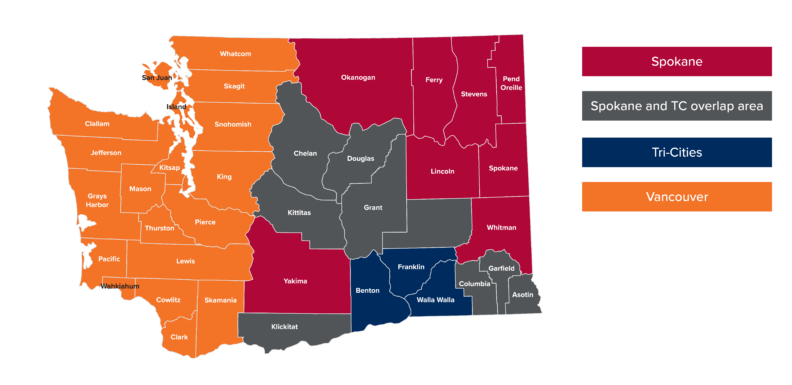
The DNP program is offered at WSU Spokane, WSU Tri-Cities, and WSU Vancouver.
Where can I complete my practicum?
Practicum hours must be completed in the catchment area of the campus of registration. That includes Washington (all campuses), Idaho (Spokane campus), and/or Oregon (Vancouver campus). WSU has clinical placement coordinators who place students for direct-care practicum experiences. DNP students must establish their own sites and preceptors for non-direct care practicum experiences. This gives students the opportunity to maximize their networking skills and existing professional connections to find a DNP project that aligns with their professional goals.
Is the PMG program offered online?
The program is considered “hybrid” with most of the instruction offered online. Most DNP courses have 6 synchronous Zoom class sessions per semester that can be attended from the student’s home – a reliable internet connection and a non-distracting environment are essential. Class sessions typically are block-scheduled in a 1-2 day block (for example: one of the class sessions might be scheduled Monday/Tuesday.) These blocked days may vary each semester.
How are classes delivered?
Class sessions are delivered live via Zoom, allowing for maximum interaction with the instructor and students from all participating campus sites.
What type of experience hours do I do as a PMG student?
DNP PMG students will complete in non-direct care practicum hours through leadership experiences and DNP project work that may involve healthcare organizations, community members, or patient populations. DNP PMG students must have 1,000 hours of practicum experiences, including those completed in the previous advanced nursing practice degree.
Where can I complete my practicum hours?
Practicum hours must be completed in the catchment area of the campus of registration. That includes Washington (all campuses), Idaho (Spokane campus), and/or Oregon (Vancouver campus). DNP PMG students must establish their own sites and preceptors for non-direct care practicum experiences. This gives students the opportunity to maximize their networking skills and existing professional connections to find a DNP project that aligns with their professional goals.
Can I complete my clinical hours where I work?
Clinical/practicum hours in the workplace follow strict requirements. You may complete clinical hours within the organization where you’re employed but not within the same unit or the same supervisory area, and no reimbursement may be given for practicum hours.
About the
Post-Masters Nurse Practitioner Track
This program typically includes coursework in advanced nursing practice, healthcare policy and advocacy, evidence-based practice, healthcare leadership, and research methods. It may also involve a clinical component where students can apply their learning in real-world healthcare settings.
Upon completion of a PM-DNP program, graduates are awarded a Doctor of Nursing Practice (DNP) degree, which is a terminal practice-focused degree that prepares nurses for advanced clinical practice, leadership positions, and research roles within the nursing profession and the broader healthcare industry.
Graduate Program Advisors

The Washington State University College of Nursing BSN, MN and DNP programs are accredited by the Commission on Collegiate Nursing Education (CCNE), 655 K. Street, NW, Suite 750, Washington, DC 20001, 202-887-6791.
