
Planetary Health and Planetary Health Report Card
What is the Planetary Health Report Card?
With the purpose of increasing planetary health awareness and accountability among medical schools, the Planetary Health Report Card (PHRC) was developed as an institutional advocacy tool in 2019 by a group of medical students at the University of California, San Francisco School of Medicine. The PHRC is a student-driven metric-based tool that aims to evaluate health professional schools on discrete metrics in five main category areas:
- Curriculum
- Interdisciplinary research in health and environment
- Community outreach and advocacy
- Support for student-led initiatives
- Campus sustainability
Originally created by medical students to assess medical schools, the report card is now being adapted and tested in nursing and pharmacy training programs, fostering interprofessional collaboration.
Assessing Nursing Curriculum
Using the Planetary Health Report Card
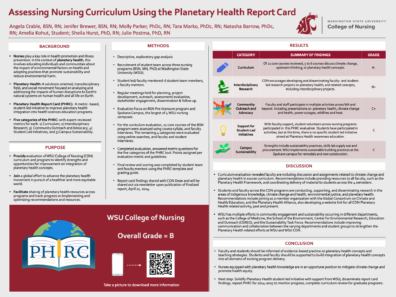
The WSU College of Nursing assessed its curriculum using the Planetary Health Report Card (PHRC), focusing on five key categories: curriculum, interdisciplinary research, community outreach and advocacy, support for student-led initiatives, and campus sustainability.
This process was led by PhD alum Dr. Molly Parker ’23 as her leadership project as a Jonas Scholar, funded by Jonas Philanthropies.
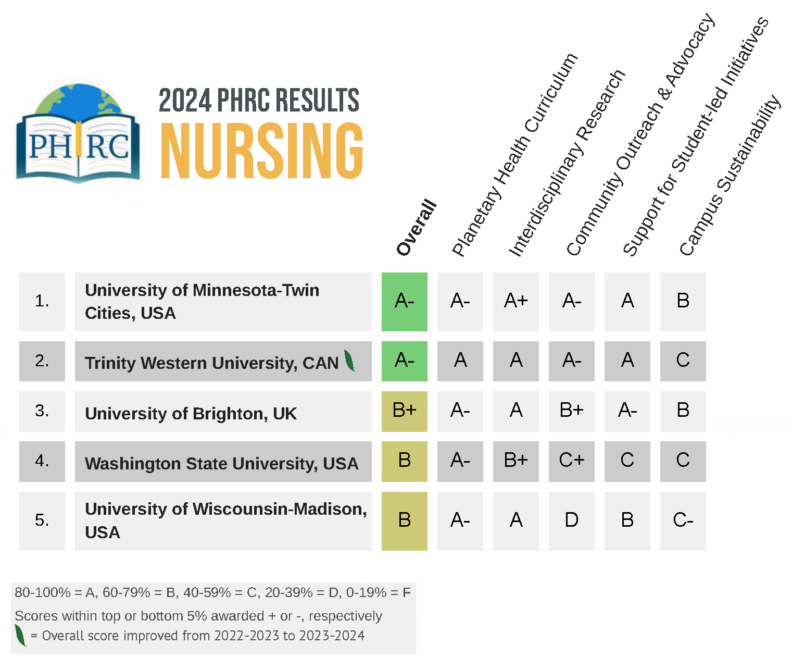
Out of 21 courses, 6 include community resilience and planetary health concepts, earning an A- for curriculum. Interdisciplinary research, which encourages planetary health projects, received a B+. However, community outreach and advocacy, support for student-led initiatives, and campus sustainability areas show room for improvement, with grades of C+, C, and C, respectively. The overall grade for the WSU College of Nursing is a B.
Presented at the Western Institute of Nursing Conference (WIN) 2024, Salt Lake City, Utah.
Credit: Angela Crable, BSN, RN; Jenifer Brewer, BSN, RN; Molly Parker, PhDc, RN; Tara Marko, PhDc, RN; Natasha Barrow, PhDc, RN; Amelia Kohut, Student; Sheila Hurst, PhD, RN; Julie Postma, PhD, RN.
Download Poster: Assessing Nursing Curriculum Using the Planetary Health Report Card (PDF)



For the planet…
Planetary health is a solutions-oriented, transdisciplinary field and social movement focused on analyzing and addressing the impacts of human disruptions to Earth’s natural systems on human health and all life on Earth.
Planetary Health Alliance
Focus Areas

Planetary Health Curriculum
Nursing programs must integrate planetary health into their curriculum to prepare nurses for addressing the health impacts of environmental crises and promoting preventative change.
2024 Grade A-
WSU College of Nursing

Interdisciplinary Research in Health and Environment
Nursing schools should support interdisciplinary research on planetary health by collaborating across health and environmental sciences to address the health effects of environmental degradation.
2024 Grade B+
WSU College of Nursing

Community Outreach and Advocacy
Institutions must partner with communities affected by environmental disruptions to advocate for change, raise awareness, and provide nursing students with meaningful engagement opportunities.
2024 Grade C+
WSU College of Nursing

Support for Student-Led Planetary Health Initiatives
Nursing programs should actively support student-led initiatives on planetary health through mentorship, funding, and hands-on opportunities that align with community projects.
2024 Grade C
WSU College of Nursing

Campus Sustainability
Healthcare institutions must foster sustainability practices, including waste management and reducing emissions, to lead the way towards a sustainable future for the health sector.
2024 Grade C
WSU College of Nursing
Overall Rankings
The Nursing Planetary Health Report Card pilot was created by an international team of nursing students and faculty, aiming to adapt the original Planetary Health Report Card to better reflect nursing’s multifaceted curriculum and patient-centered care. Involving participants from institutions in the U.S., UK, and Germany, the team broadened metrics to include various nursing degrees while focusing on areas such as bedside care, interprofessional collaboration, and administrative support. Throughout the process, the team gained insights into how nursing programs can incorporate planetary health education, recognizing nurses’ critical role in addressing climate change. As they distribute the pilot internationally, they hope to empower nursing students to drive change within their programs for future generations.
Report Cards
2024 Nursing Planetary Health Report Card (PDF)
2024 WSU College of Nursing Planetary Health Report Card (PDF)
Focus Areas
Planetary Health Curriculum
Planetary Health Curriculum focus area examines how well the nursing program integrates climate change, environmental health, and planetary health concepts into its courses, including their impact on individual and community health, mental health, infectious disease patterns, food and water security, and marginalized populations. It also assesses how the program addresses sustainable healthcare, such as plant-based diets, the carbon footprint, and waste management in healthcare systems, along with the inclusion of Indigenous knowledge and strategies for discussing these issues with patients.
General results: Planetary Health Curriculum focus area examines how well the nursing program integrates climate change, environmental health effects on health, extreme weather, and their implications on mental and physical well-being. Recommendations for enhancing the curriculum include better integration of planetary health concepts across assignments, lectures, and discussions, and the training of faculty to utilize evidence-based resources.
Interdisciplinary Research in
Health and the Environment
The Interdisciplinary Research focus area explores faculty engagement in planetary health research, the presence of dedicated research centers, support for scholarly dissemination, and community involvement in shaping research agendas. It also looks at the availability of a centralized planetary health website, the hosting of related conferences, and membership in relevant organizations.
General results: WSU College of Nursing encourages faculty and student-led research on planetary health, promoting interdisciplinary approaches. There is a focus on areas like environmental health, climate change impacts, health equity, and sustainability. Faculty actively engage in and disseminate research related to these themes. A recommendation is to create a centralized webpage to highlight planetary health research, facilitate collaborations, and possibly join networks like the Global Consortium on Climate and Health Education (GCCHE).
Community Outreach and Advocacy in
Environment and Health
Community Outreach and Advocacy focuses on partnerships with community organizations, availability of courses or events for public education on planetary health, regular communications on sustainability, continuing education opportunities, policy advocacy, and partnerships with healthcare institutions for public education.
General results: WSU College of Nursing participates in a variety of community outreach and advocacy activities related to planetary health. These include educational presentations on climate change, wildfires, and health. Efforts are made to engage with local, state, national, and international communities. However, there is a recommendation to strengthen partnerships with regional organizations, community groups, and healthcare providers to enhance education and advocacy efforts around planetary health and sustainability.
Support for Student-Led Planetary Health Initiatives
The Support for Student-Led Initiatives focus area assesses whether there are opportunities for student representation in decision-making on planetary health, dedicated student groups with faculty support, research opportunities, support for student-led sustainability projects, and chances for students to teach or present on related topics. It also evaluates the presence of co-curricular initiatives, such as community resilience projects, speaker series, and cultural events.
General results: Although some student-led projects exist on topics like climate change and sustainability, there is no specific student initiative dedicated to planetary health education. Student volunteers have contributed to preparing and engaging in the Planetary Health Report Card (PHRC) evaluation. A recommendation is to establish a student task force focused on planetary health, supported by faculty and administrators, and to develop a dedicated planetary health section on the College of Nursing website.
Campus Sustainability
Sustainability initiatives are among the most visible aspects of planetary health efforts, especially in higher education. The healthcare sector has a critical role in addressing environmental impacts, as it is a major contributor to greenhouse gas emissions and pollution. By integrating sustainability practices, the healthcare industry can help protect and restore local and global ecosystems. This focus area explores the commitment of WSU College of Nursing to sustainable operations, including renewable energy use, waste reduction, and eco-friendly procurement, to ensure a healthier future.
General results: WSU has strengths in sustainability practices, particularly regarding lab supplies, sustainable procurement, and building practices on the Spokane campus. However, there is a need for a comprehensive plan for carbon neutrality and divestment from fossil fuels. The report recommends developing sustainability guidelines for events, training, composting, and dining practices, and enhancing collaboration with the WSU Sustainability Task Force.
Resources for Students & Faculty
Books
Alliance of Nurses for Healthy Environments: Environmental Health In Nursing 3rd ed. Book (PDF)
Planetary Health Alliance: Planetary Health: Protecting Nature to Protect Ourselves
Training Opportunities
Eco America ANHE Climate for Health Ambassador Training, Certificate of Completion, Intended Audience: Nursing professionals. Earn 3 CE credits.
Coursera (FREE)- Planetary Health for Nurses
Videos
Planetary Health Alliance: YouTubeChannel
Planetary Health Alliance: The Promise of Planetary Health
Introduction to the Planetary Health Education Framework (PHEF)
CUGH–Webinar: Planetary Health Education Framework
In It Together: Promoting Planetary Health (Webinar)
Nursing Science & Education in the Anthropocene – Planetary Health
Climate Change – A Short Film [4K]
Planetary Health: The Future is Now
UMN School of Nursing Planetary Health Guest Lecture: Indigenous Perspectives on Planetary Health
Planetary Health Websites
GLOBAL
- Global Consortium on Climate and Health Education: Climate Resources for Health Education
- Sao Paulo Declaration on Planetary Health
- Health care without harm
- The Global Climate and Health Alliance
- United Nations: Climate Action
- Climate Action . org
- Women’s Earth & Climate Action Network, International
GOVERNMENT
- The Intergovernmental Panel on Climate Change
- Climate Change 2023 Synthesis Report – The Planetary Health Roadmap and Action Plan (PDF)
- World Health Organization: Climate Change and Health
- World Health Organization: Fast Facts on Climate and Health
- Centers for Disease Control and Prevention: Climate & Health
- NOAA Climate.gov
- NASA: Climate Change
- National Institute of Health: Climate Change and Health Initiative
UNITED STATES
- Planetary Health Alliance
- Roadmap to Planetary Health (PDF)
- The Rockefeller Foundation: The Lancet Commission on Planetary Health: Safeguarding Human Health in the Anthropocene Epoch (PDF)
- The Lancet Planetary Health home page
- U.S Climate and Health Alliance
- U.S Environmental Protection Agency (EPA): Climate Change and Human Health
- University of Minnesota: School of Nursing Center ofr Planetary Health
- Practice Greenhealth: Sustainability Solutions for Healthcare
- Climate for Health
- Climate Central
- United States Climate Alliance: Members
- U.S Climate and Health Alliance
NURSING
- Alliance of Nurses for Healthy Environments (ANHE)
- Nurses Climate Challenge: Education
- American Nurses Association (ANA): Environmental Health
- American Nurses Association-Planetary and Global Health: IAC Planetary and Global Health Resources 2024 (PDF)
- National Student Nurses Association: NSNA and Climate Change
- Nurses Drawdown: Nurses Standing up to Climate Change
- National League for Nursing: Climate
- American Nurses Association (ANA): Official Position Statements on Climate Change
- Planetary Health Report Card
- National Nurses United
- Washington State Nurses Association: Climate Challenge
PLANETARY HEALTH LITERATURE
- Demorest, S., Cook, C., Schenk, E., Harris, L., & Earley, A. (2024). School of nursing climate commitment: Nursing faculty bring climate to the classroom. International Journal of Environmental Research and Public Health, 21(5), 589. https://doi.org/10.3390/ijerph21050589
- Brand, G., Wise, S., Bedi, G., & Kickett, R. (2023). Embedding indigenous knowledges and voices in planetary health education. The Lancet Planetary Health, 7(1), e97–e102. https://doi.org/10.1016/s2542-5196(22)00308-4
- Evans‐Agnew, R., LeClair, J., & Sheppard, D. (2023). Just‐relations and responsibility for planetary health: The global nurse agenda for climate justice. Nursing Inquiry, 31(1). https://doi.org/10.1111/nin.12563
- Glauberman, G., Bray, M., & Freeman, K. (2023). Planetary health and nursing: A call to action. Hawai’i Journal of Health & Social Welfare, 82(5), 120–122.
- Portela Dos Santos, O., Melly, P., Joost, S., & Verloo, H. (2023). Climate change, environmental health, and challenges for nursing discipline. International Journal of Environmental Research and Public Health, 20(9), 5682. https://doi.org/10.3390/ijerph20095682
- Redvers, N., Faerron Guzmán, C. A., & Parkes, M. W. (2023). Towards an educational praxis for planetary health: A call for transformative, inclusive, and integrative approaches for learning and relearning in the anthropocene. The Lancet Planetary Health, 7(1), e77–e85. https://doi.org/10.1016/s2542-5196(22)00332-1
- Vandenberg, S. Y. (2023). Planetary health. Nurse Educator, 48(6), 293–297. https://doi.org/10.1097/nne.0000000000001420
- Amerson, R. M., Boice, O., Mitchell, H., & Bible, J. (2022). Nursing faculty’s perceptions of climate change and sustainability. Nursing Education Perspectives. https://doi.org/10.1097/01.nep.0000000000000991
- LeClair, J., & Potter, T. (2022). Planetary health nursing. AJN, American Journal of Nursing, 122(4), 47–52. https://doi.org/10.1097/01.naj.0000827336.29891.9b
- Redvers, N., Celidwen, Y., Schultz, C., Horn, O., Githaiga, C., Vera, M., Perdrisat, M., Mad Plume, L., Kobei, D., Kain, M. C., Poelina, A., Rojas, J. N., & Blondin, B. (2022). The determinants of planetary health: an Indigenous consensus perspective. The Lancet. Planetary health, 6(2), e156–e163. https://doi.org/10.1016/S2542-5196(21)00354-5
- Astle, B. (2021). Planetary health in nursing: A transdisciplinary equity-centered approach. Creative Nursing, 27(4), 237–241. https://doi.org/10.1891/cn-2021-0027
- Butterfield, P., Leffers, J., & Vásquez, M. (2021). Nursing’s pivotal role in global climate action. BMJ, n1049. https://doi.org/10.1136/bmj.n1049
- Ergin, E., Altinel, B., & Aktas, E. (2021). A mixed method study on global warming, climate change and the role of public health nurses from the perspective of nursing students. Nurse Education Today, 107, 105144. https://doi.org/10.1016/j.nedt.2021.105144
- Iyer, H. S., DeVille, N. V., Stoddard, O., Cole, J., Myers, S. S., Li, H., Elliott, E. G., Jimenez, M. P., James, P., & Golden, C. D. (2021). Sustaining planetary health through systems thinking: Public health’s critical role. SSM – Population Health, 15, 100844. https://doi.org/10.1016/j.ssmph.2021.100844
- Rogers, H. (2021). A daily practice for planetary health. Creative Nursing, 27(4), 267–268. https://doi.org/10.1891/cn-2021-0025
- Barna, S., Maric, F., Simons, J., Kumar, S., & Blankestijn, P. J. (2020). Education for the anthropocene: Planetary health, sustainable health care, and the health workforce. Medical Teacher, 42(10), 1091–1096. https://doi.org/10.1080/0142159x.2020.1798914
- Kalogirou, M., Olson, J., & Davidson, S. (2020). Nursing’s metaparadigm, climate change and planetary health. Nursing Inquiry, 27(3). https://doi.org/10.1111/nin.12356
- Moysés, S. J., & Soares, R. C. (2019). Planetary health in the anthropocene. Health Promotion International, 34(Supplement_1), i28–i36. https://doi.org/10.1093/heapro/daz012
- Potter, T. (2019). Planetary health: The next frontier in nursing education. Creative Nursing, 25(3), 201–207. https://doi.org/10.1891/1078-4535.25.3.201
- Leffers, J., Levy, R., Nicholas, P. K., & Sweeney, C. F. (2017). Mandate for the nursing profession to address climate change through nursing education. Journal of Nursing Scholarship, 49(6), 679–687. https://doi.org/10.1111/jnu.12331
- The Lancet Health and Climate Policy (PDF)
- The Lancet: Views of health professionals on climate change and health: a multinational survey study
- The Lancet: Planetary health learning objectives: foundational knowledge for global health education in an era of climate change (PDF)
- Climate Change and Population Health: Incorporating Stages of nursing Political development
PLANETARY HEALTH REPORT CARD LITERATURE
- The Planetary Health Report Card (PHRC) 2024: Inspiring Change in Healthcare Education
- Hampshire, K., Islam, N., Kissel, B., Chase, H., & Gundling, K. (2022). The planetary health report card: A student-led initiative to inspire planetary health in medical schools. The Lancet Planetary Health, 6(5), e449–e454. https://doi.org/10.1016/s2542-5196(22)00045-6
INDIGENOUS VOICES
- Just‐relations and responsibility for planetary health: The global nurse agenda for climate justice
- ‘A change of heart’: Indigenous perspectives from the Onjisay Aki Summit on climate change (PDF)
- Indigenous perspectives on education for sustainable healthcare
- Two-Eyed Seeing and other lessons learned within a co-learning journey of bringing together indigenous and mainstream knowledges and ways of knowing (PDF)
- Just transition in the northwest territories: Insights and values from indigenous and non-indigenous northerners (PDF)
- The determinants of planetary health: an Indigenous consensus perspective
- Molecular Decolonization: An Indigenous Microcosm Perspective of Planetary Health (PDF)
- How Indigenous Communities Are Adapting To Climate Change: Insights From The Climate-Ready Tribes Initiative (PDF)
- Tribally led planetary health education in southeast Alaska (PDF)
- Indigenous Peoples: Traditional knowledges, climate change, and health (PDF)
- Climate change, biodiversity loss, and Indigenous Peoples’ health and wellbeing: A systematic umbrella review (PDF)
Frequently Asked Questions
What is the purpose of the Planetary Health Report Card in nursing?
The Planetary Health Report Card (PHRC) is a tool designed to evaluate and improve how nursing programs integrate planetary health topics into their curriculum, research, community outreach, and sustainability practices. It assesses strengths and areas for growth to ensure future nurses are well-equipped to address environmental health issues and climate change’s impacts on health.
How is planetary health incorporated into nursing curricula?
The nursing curriculum is evaluated on how it includes topics such as the impact of extreme weather events, climate change on health, food and water security, pollution, infectious diseases, and the relationship between ecosystem health and human health. The PHRC also looks at how the curriculum teaches sustainable healthcare practices, emphasizes indigenous and traditional knowledge systems, and includes strategies for discussing environmental issues with patients and other health professionals.
What benefits come from integrating planetary health into nursing education?
By integrating planetary health into nursing education, future nurses are better prepared to address the health impacts of climate change, advocate for sustainable healthcare practices, and support affected communities. It enhances their ability to understand and mitigate the effects of environmental degradation on human health and provides them with the skills to work towards a more sustainable healthcare system.
How do nursing programs engage in community outreach related to planetary health?
Community outreach efforts may include partnerships with local or regional organizations to promote environmental health education, public-facing events or courses on planetary health, and advocacy for policies addressing sustainability and climate change. Nursing programs often look for opportunities to share information on climate change, health equity, and resilience to environmental disruptions with the broader community.
WSU College of Nursing Faculty
Faculty supporting planetary health through education and research.
Program Advisors
About this page
This Planetary Health Report Card page is the result of a Master of Nursing project by Angela Crable, BSN, RN, CWOCN, at the WSU College of Nursing. Her work focused on integrating planetary health concepts into nursing education as part of a quality improvement initiative, aiming to enhance nursing students’ understanding of the vital connection between environmental sustainability and health outcomes.
