- Mary Hieb
- Summer 2026
Faculty instructor: Kelsey Pascoe
Abstract
Background
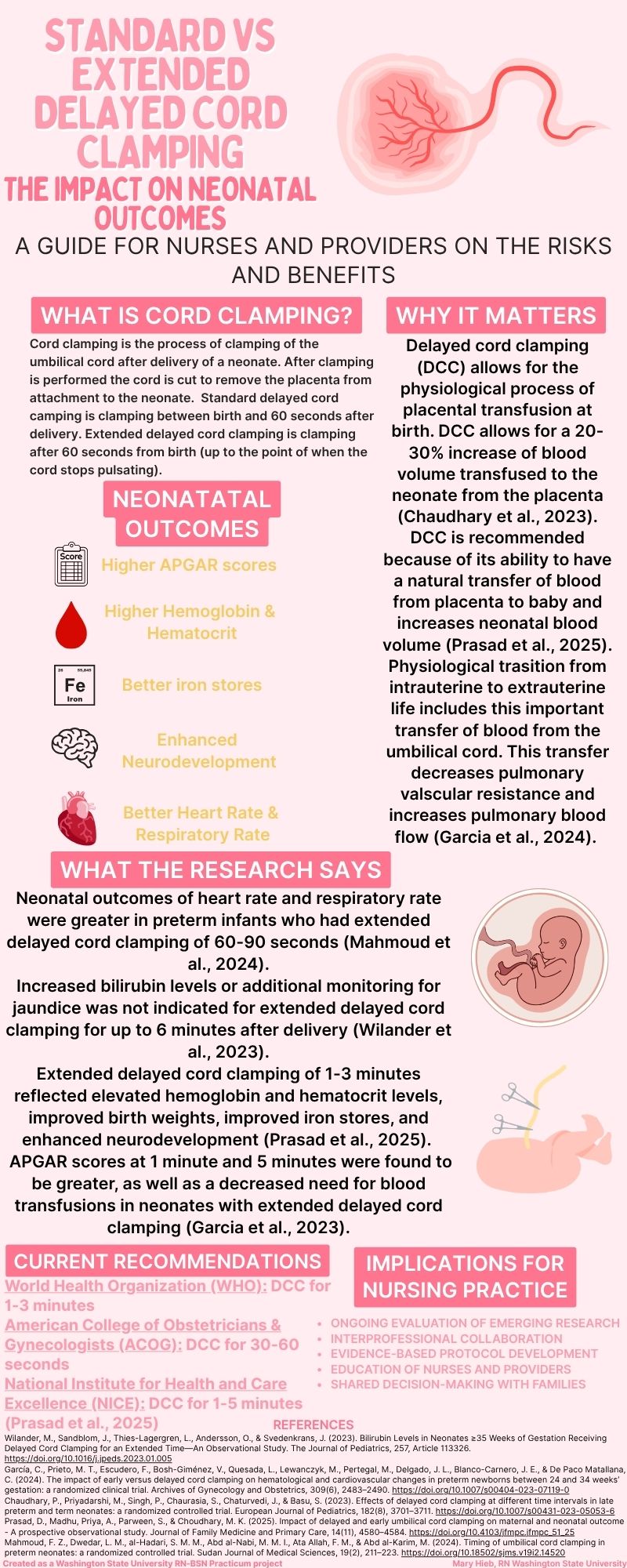
Delayed cord clamping is an evidence-based practice that is recommended by professional organizations because it improves neonatal blood volume, hemoglobin and hematocrit levels, iron stores, and physiological transition after birth. Current evidence recommends standard delayed cord clamping of up to 60 seconds after birth. Emerging evidence though suggests that extended delayed cord clamping greater than 60 seconds, and up to until the cord stops pulsating, may provide additional neonatal benefits.
Purpose
The purpose of this scholarly research project was to synthesize and critically appraise the current literature comparing standard (up to 60 seconds) and extended delayed cord clamping(greater than 60 seconds) to determine if extended delayed cord clamping is associated with improved neonatal outcomes.
Methods
A review of recent peer-reviewed literature published no earlier than 2023 was conducted using studies that evaluated neonatal outcomes associated with standard and extended delayed cord clamping. Current clinical recommendations from professional organizations were reviewed, and findings were synthesized in these studies to evaluate neonatal outcomes including hemoglobin and hematocrit levels, iron stores, APGAR scores, heart rate, respiratory rate, bilirubin levels, and need for blood transfusion. Stakeholder interviews were also done with labor and delivery nurses, family medical providers, and pediatricians. All stakeholders identified concerns regarding an increased risk of jaundice and the potential need for phototherapy as a barrier for wanting to implement extended delayed cord clamping as a standard of care.
Discussion
Current evidence supports delayed cord clamping as a standard of care, and further evaluations shows that extended delayed cord clamping may further improve neonatal hematologic and physiologic outcomes without increasing adverse effects such as jaundice and the need for phototherapy. Although findings are promising, there is still variability among study designs and clamping intervals which limits definitive conclusions. Additional randomized controlled trials could help close the gap and establish better standardized recommendations for extended delayed cord clamping. Continued evaluation of any emerging evidence, interprofessional collaboration, provider and nurse education, and evidence-based policy development are essential for future clinical practice and optimization on neonatal outcomes.
Keywords: delayed cord clamping, extended delayed cord clamping, neonatal outcomes, evidence-based practice